

Why defensive riding still wins every time
Riding defensively is not about being timid. It's about increasing the margin between you and trouble so you can live with less luck and more skill. Years on tracks and streets teach a single truth: most collisions are chain reactions you can break early with simple, repeatable habits.
Core question 1 — How far will I travel before I stop?
Short answer: a lot farther than you think if you count human reaction. Stopping distance comprises two parts: thinking (reaction) distance and braking distance. Experienced riders can react in under half a second in controlled tests, but typical street reaction times commonly sit between about 0.7 and 1.0 seconds for everyday scenarios.
At 60 mph, the pure braking distance often quoted ranges from roughly 120 to 180 feet depending on surface and tire grip. Add reaction time and that number can climb dramatically. Using conservative street assumptions (longer reaction time and average braking force), stopping from highway speeds can exceed 300 feet.
Practical takeaway: never assume you can stop "in time" without leaving a large safety buffer. Set following distance and speed to match conditions so your total required stopping space is available.
Core question 2 — How hard can I brake?
Most street riders generate about 0.6 g deceleration in emergency stops. With firm technique and modern ABS, riders can reach around 0.9 g. Racing and elite track riders briefly exceed 1.0 g under ideal conditions, but that level demands perfect tires, pavement, and body position.
That difference is massive. Braking force scales quadratically with speed. Double your speed and stopping distance quadruples. Respect that math on every ride.
Core question 3 — When should I swerve versus brake?
Decision time is short and the wrong reflex costs lives. The practical rule: if there’s a clean, known escape lane and no oncoming hazard, a controlled swerve or lane-change can reduce collision energy. If you must reduce speed substantially and the escape path is narrow or unpredictable, prioritize controlled, firm braking and use trail braking only if you know how to do it safely.
Key factors that drive the decision: road surface, visibility of the escape route, traffic around you, and your confidence in executing the maneuver. Train both options on a closed course so your responses in the street are mechanical, not panicked.
Braking technique that actually works
Start with the basics: progressive, full front brake combined with the rear to stabilize. On modern bikes with ABS, squeeze progressively to full force and hold — ABS will modulate if the front wheel nears lock. On non-ABS bikes, learn threshold braking: brake hard until just before lock-up, release slightly, and re-apply.
Body position matters. Move your weight rearward, but stay light on the bars by squeezing the tank with your knees. This preserves traction on the front wheel and reduces rider fatigue during long braking events.
Steering and stability: countersteering and quick lane changes
Countersteering is the quickest, most stable way to initiate a direction change at speed. Push the bar on the side you want to turn away from — it’s rapid and precise. For emergency lane-changes, maintain throttle neutrality: abrupt throttle changes upset weight distribution and traction.
Practice short, sharp inputs at low speed in a controlled environment. Building the motor pattern ahead of time makes the movement automatic when you need it.
Vision: where you look determines where you go
Scan early and often. Focus at least 12–15 seconds down the road in town; more on open roads. Identify hazards before they become crises: parked cars, pedestrian sightlines, vehicles at intersections, and driveway mouths.
A common failure is target fixation — staring at the hazard instead of your escape path. Train your eyes to lock onto the clear lane or the edge of a hazard you can use as a reference. Your hands and bike will follow where your head points.
Adapting to surface and weather
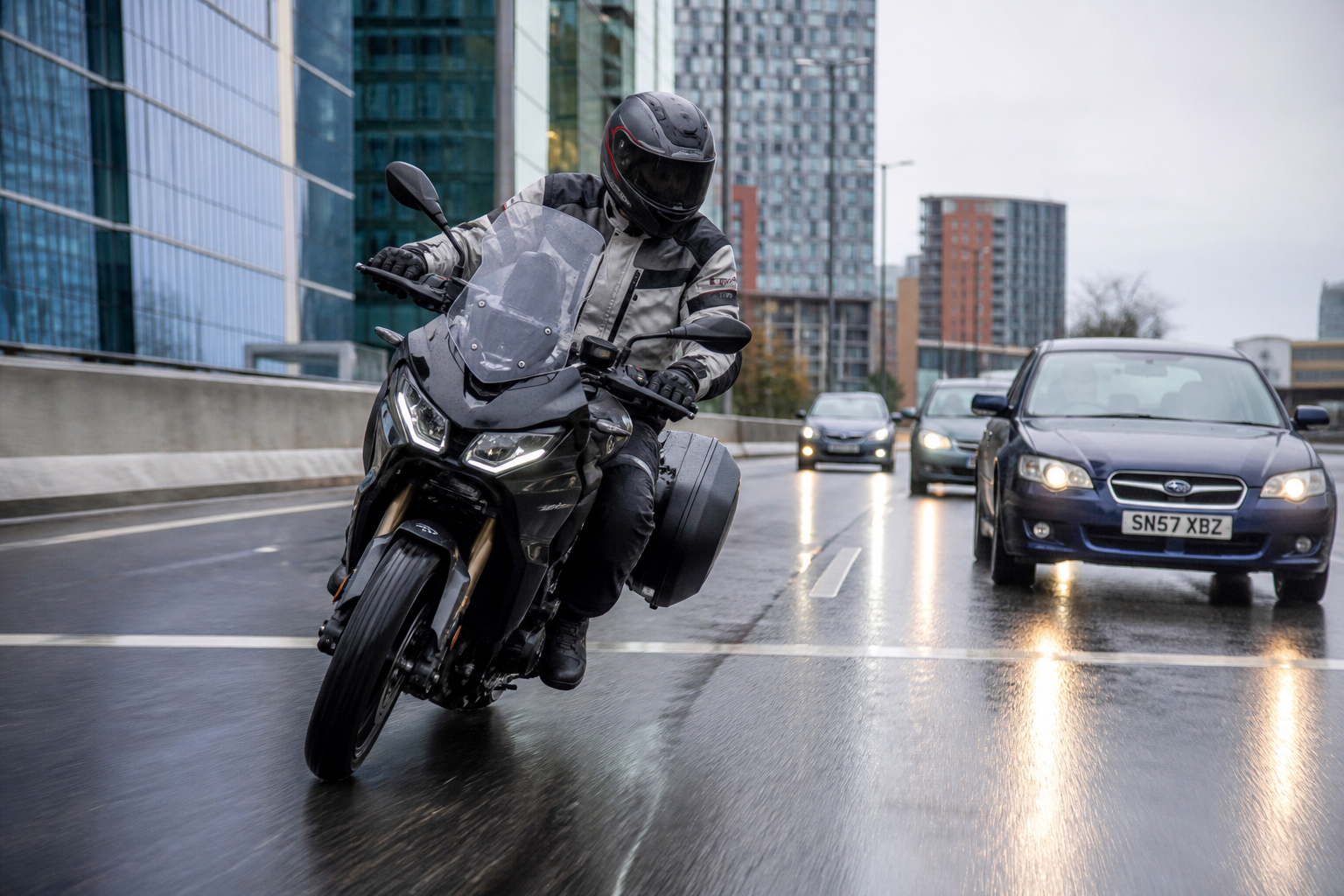
Wet, greasy, or cold surfaces cut tire grip dramatically. Reduce speed early, increase following distance, and soften inputs. In the rain, be wary of painted lines, manhole covers, and metal grates. In cold conditions, allow tires time to heat and avoid aggressive weight transfers until the rubber comes up to temperature.
Protective gear that keeps you riding another day
Helmets must meet legal and practical standards. In the U.S., look for DOT certification. In Europe, ECE 22.06 is the current standard with rigorous testing. For track days or higher safety margins, Snell certified helmets are common, though rules vary by organizer. Pick a helmet that fits well — retention and fit trump flashy features.
Beyond helmets, wear CE-rated armor in jacket, pants, and gloves, and choose boots built for shifting and ankle protection. A well-chosen outfit reduces injury severity and lets you ride with more confidence.
Maintenance checks that are actually critical
- Tires: pressure and tread depth. Underinflation eats braking performance.
- Brakes: pad thickness and fluid condition. Soggy brakes mean longer stopping distances.
- Suspension: settings. A sagging front end loses bite under hard braking.
- Lights: visibility. Functioning lights and clean lenses buy fractions of seconds in detection.
Run a quick pre-ride check every time. It takes less than a minute and prevents most mechanical surprises.
Mental preparedness and the avoidance mindset
Defensive riding is a thinking skill as much as a physical one. Expect others to make errors and give yourself options: slow, shift, steer. Complacency is the quiet killer — the moment you assume being right is enough is the moment you stop seeing real risk.
Use a 2–3 second buffer in town and a 4–6 second buffer on open roads as defaults; expand them in poor conditions. That buffer creates time to choose deliberately instead of react desperately.
Training drills you can and should practice
- Emergency stop from 30–50 mph: practice progressive full-front braking with a focus on smooth weight transfer.
- Low-speed control: tight figure-eights and U-turns to improve throttle and clutch finesse.
- Lane-change drills: at moderate speed, pair countersteering with a steady throttle to simulate evasive moves.
- Combined braking and steering: gradually practice light braking into a mild turn, increasing confidence with traction limits.
Repeat these drills until they’re reflexive. Then test them periodically under different conditions.
What to do immediately after a near-miss
Pull over safely if needed. Breathe and unload the adrenaline by relaxing your grip and shoulders. Check the bike for damage and check yourself for injuries. Reflect briefly on what you learned and how to avoid similar situations. If you walked away, you earned a reset to ride smarter.
A short practical checklist before every ride
- Helmet and armor on; visor clean.
- Tire pressures visually checked and correct for load.
- Brake lever feel crisp; no sponginess.
- Lights and signals working; mirrors set for minimal blind spots.
- Escape routes and likely hazards mentally pre-scanned for your route.
Final practical rules to ride by
Keep speed matched to the environment, always carry an escape plan, and practice the physical maneuvers until they’re automatic. Put your time and money into training and protective gear first — they pay dividends when luck runs out.
If you take one thing from this guide: leave room for error. You can’t control other road users, but you can control how much space you give yourself to manage their mistakes.
Useful next steps
Book a certified advanced rider course, run the emergency drills weekly in a safe area, and create a personal maintenance checklist attached to your bike. Those three actions compress hours of dangerous uncertainty into usable skills.


0 Comments