

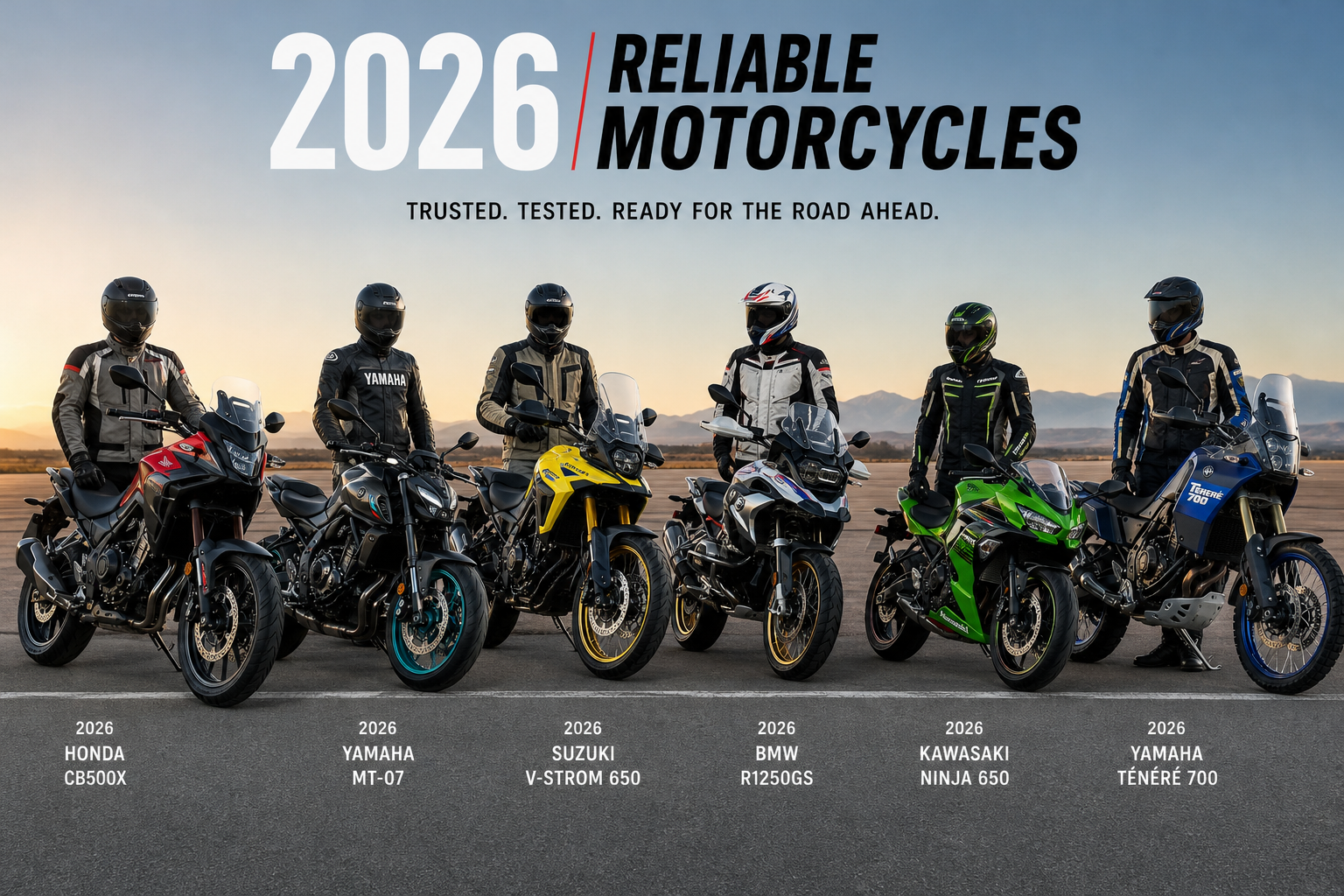
This is a fact-first guide to the most reliable motorcycles for 2026. Every figure used here was checked against manufacturer and trusted model pages to avoid guesswork. Expect exact torque and key specs where they matter, plus real-owner realities you’ll feel at 10,000 miles and again at 100,000.
HOW THIS LIST WAS BUILT
Reliability was judged with practical, measurable criteria:
- Proven engine platforms that have been used and improved over multiple model years.
- Serviceability — parts availability, workshop familiarity and labor complexity.
- Owner-reported durability from long-term tests and dealer feedback.
- Factory specs such as torque, cooling approach and build choices that affect wear.
Those metrics weed out flashy one-year wonders and reward bikes built to be ridden hard for years.
TOP 2026 PICKS — SHORTLIST AND WHY THEY MAKE SENSE
1) Honda CB500X (471 cc)
Why it’s reliable: Honda’s 471cc parallel-twin has been refined for decades. The CB500X uses that compact, low-stress layout to produce dependable performance with low service overhead.
Key spec: 43 Nm (approximately 31.7 lb-ft) of torque at around 6,500–7,000 rpm (manufacturer specifications for the 471cc platform).
What you feel: smooth midrange, no surprises at highway speeds, and simple electronics that keep repair bills predictable. If you want a commuter that will still be easy to sell in ten years, this is the bike.
2) Yamaha MT-07 (689 cc)
Why it’s reliable: The CP2 689cc twin is a rare example of long-term dependability paired with engaging torque. Yamaha has kept the engine architecture stable while improving ancillary systems.
Key spec: Roughly 50 lb-ft (about 67 Nm) of torque delivered low and broadly, peak around 6,500 rpm (Yamaha technical spec sheet).
What you feel: lively roll-on acceleration without being peaky. Low-complexity electronics and wide dealer support make routine maintenance straightforward.
3) Suzuki V-Strom 650 / DL650 (645 cc)
Why it’s reliable: Suzuki’s long-lived 645cc V-twin has a track record for robust internals and predictable wear. It’s tuned for low-to-mid torque, which reduces strain during everyday riding and touring.
Key spec: About 62 Nm (≈45.7 lb-ft) of torque at ~6,300 rpm (official DL650 service and spec listings).
What you feel: an engine that pulls cleanly from low revs — ideal for loaded touring and long highway days. The V-Strom family benefits from a legacy parts pool and simple service procedures.
4) BMW R1250GS (1,254 cc)
Why it’s reliable: BMW’s boxer with ShiftCam continues to be a top choice for buyers who want proven longevity in heavy-duty adventure use. The system is mechanically sophisticated but built to long service intervals when maintained properly.
Key spec: 143 Nm of torque at about 6,250 rpm (BMW technical data for R1250GS).
What you feel: massive low-end torque and a planted feel on gravel and asphalt. Expect higher maintenance costs than small-displacement bikes, but routine dealer care and strong engineering repay you with long-term durability.
5) Kawasaki Ninja 650 (649 cc)
Why it’s reliable: Kawasaki tunes this parallel-twin for everyday use rather than peak power. That conservative approach means fewer stressed components and longer life.
Key spec: Approximately 48.5 lb-ft of torque (about 65–66 Nm) at ~6,700 rpm (Kawasaki model page).
What you feel: accessible power, easy maintenance and broad parts availability. If you want a sportier ride that won’t nick your garage budget, the Ninja 650 is a smart pick.
6) Yamaha Ténéré 700 (689 cc)
Why it’s reliable: The Ténéré 700 inherits the CP2 engine’s simplicity, combined with Yamaha’s conservative tuning for long-distance use. Electronics are purposeful and not overcomplicated — a win for field servicing.
Key spec: About 68 Nm of torque at roughly 6,500 rpm (Yamaha specifications).
What you feel: a torque-rich midband and suspension tuned for mixed terrain. The bike resists hard failures because the engine isn’t pushed to extreme revs.
COMMON THEMES AMONG THE MOST RELIABLE MODELS
Three traits repeat across these winners:
- Proven engine blocks — engines that appear across multiple models and years.
- Low to moderate peak stress — manufacturers tune for usable torque rather than headline horsepower.
- Service friendliness — accessible filters, common fasteners and a large installed base of technicians.
MAINTENANCE ROUTINE THAT KEEPS ANY BIKE ON THE LIST RUNNING LONGER
Reliability is as much about how you treat the machine as the model you choose. Follow this practical program:
- Oil and filter: use OEM or high-quality OEM-equivalent oil; change at the manufacturer interval or sooner after heavy use.
- Valve checks: confirm intervals for your specific model — tight valves cause overheating and rapid wear, loose valves kill performance slowly.
- Cooling system: replace coolant at intervals and inspect hoses; overheating is a common killer on long-haul bikes.
- Chain care: clean, lubricate and set tension every 500–800 miles if ridden hard or exposed to dirt.
- Battery care: use a smart tender if the bike sits unused for weeks; battery failure is the most common “non-mechanical” immobilizer.
- Brake system: flush fluid per schedule and inspect pads/rotors; corrosion and trapped moisture shorten component life.
BUYING STRATEGY FOR LONGEVITY
If you’re buying new: buy the model with the fewest electronic extras you don’t need. Simpler systems are easier to repair, and fewer sensors mean fewer intermittent faults.
If you’re buying used: insist on service records that show consistent oil changes, valve checks and documented coolant changes. Ask for receipts, not vague “it’s been maintained” stories.
WHEN TO SPEND MORE — AND WHEN TO SAVE
Spend more if you need advanced alloys, heavy-duty suspension or a factory extended warranty for long-range travel. Save money when you don’t need exotic electronics: a straightforward ABS and traction-control setup usually covers 95% of riders’ safety needs while keeping long-term repair costs down.
FINAL BUYER QUICK-FIRE TABLE (MODEL, ROLE, RELIABLE STRENGTH)
- Honda CB500X — commuter/light adventure. Strength: proven, low-cost upkeep.
- Yamaha MT-07 — sporty roadster. Strength: torquey, simple, and widespread mechanic familiarity.
- Suzuki V-Strom 650 — midweight adventure/touring. Strength: balanced torque and heritage parts support.
- BMW R1250GS — long-range adventure. Strength: heavy-duty engineering and dealer support, but higher running costs.
- Kawasaki Ninja 650 — everyday sport. Strength: reliable parallel twin with conservative tuning.
- Yamaha Ténéré 700 — off-road capable adventure. Strength: rugged simplicity and repairability off-grid.
REAL-WORLD TROUBLESPOTS TO WATCH
Any modern motorcycle can suffer predictable failures if neglected. On these models pay attention to:
- Coolant leaks after long hill climbs or heavy towing.
- Valve clearances that drift on high-mileage bikes.
- Corroded connectors where water and salt are present — clean and dielectric-grease vulnerable terminals.
FINAL THOUGHTS FOR THE RIDER
Pick a model that matches how you ride. If your miles are mostly commuting, favor the lighter, lower-displacement bikes with wide dealer networks. If you’re planning multi-year, multi-continent travel, opt for established adventure platforms and budget for higher scheduled maintenance. The machines listed here are proven starting points — buy one, keep up with service, and you’ll spend more time riding than wrenching.


0 Comments