

AN OVERVIEW: WHY 2026 MATTERS FOR TRIUMPH
Triumph arrived at 2026 with a broad, sharpened range. The company didn’t tinker at the edges — it rearranged priorities. New mid-capacity fighters, serious updates to Modern Classics, and higher-tech trims across the Adventure and Roadster lines show a brand pushing performance, accessibility, and tech at once.
What you’ll read next is drawn from Triumph’s official releases and first-ride reporting. These notes are based on what Triumph released for 2026.
STRATEGY: A LINEUP THAT SCALES FROM 400cc TO 1,160cc
Triumph’s 2026 range spans everything from entry-level 400cc models to flagship 1,160cc triples. That breadth matters: buyers can step into a Tracker 400 or Thruxton 400, graduate to the mid-capacity Trident/Trident 800 family, then graduate again to the Tiger 1200 and Speed Triple 1200. It’s a deliberate funnel that keeps the brand accessible while protecting flagship cachet.
KEY MODELS AND WHAT IS NEW
Tiger 1200 — The tech-forward adventure flagship
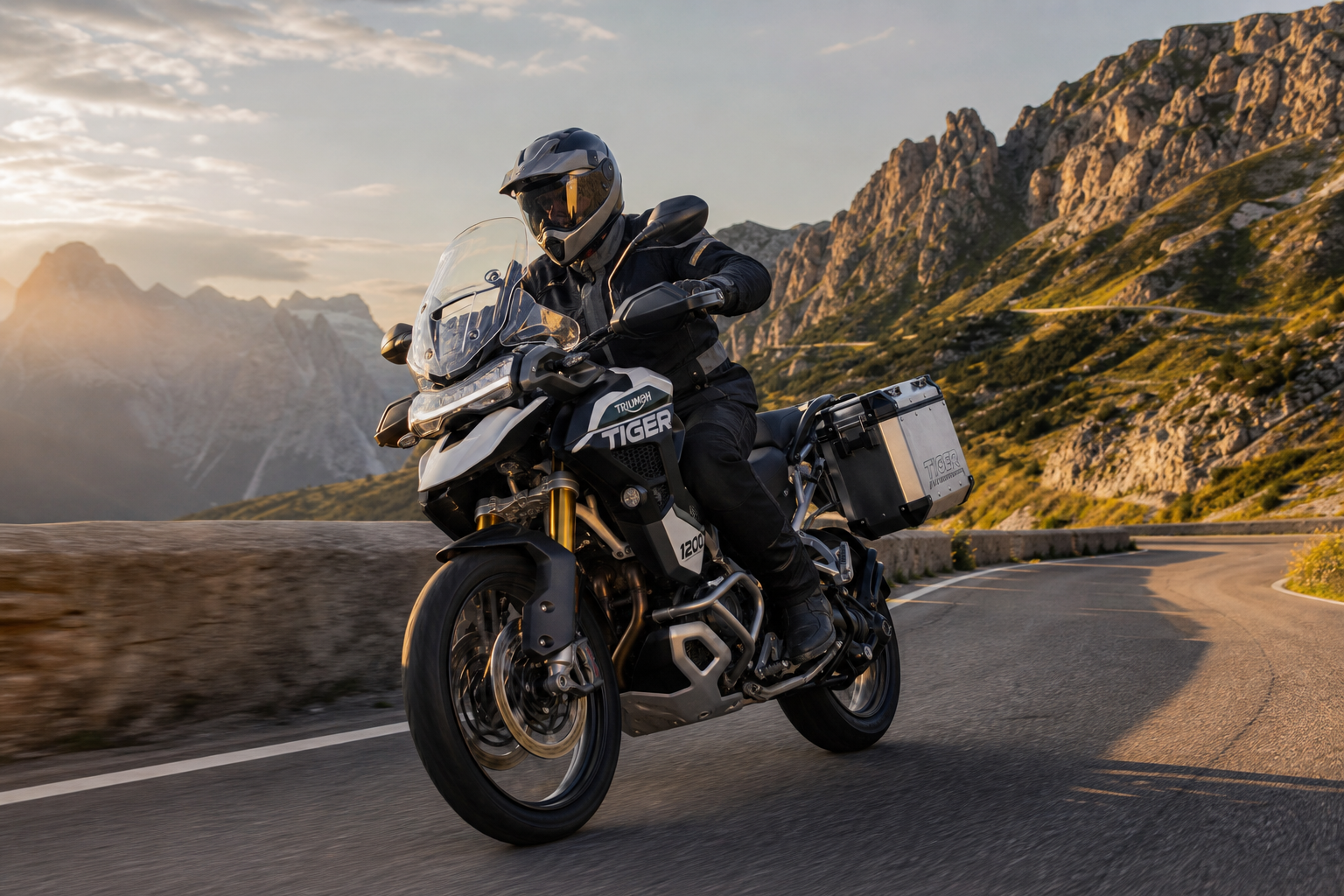
The Tiger 1200 is the poster bike for Triumph’s engineering muscle in 2026. The 1,160cc T-Plane triple produces roughly 147 HP (150 PS) at 9,000 rpm and 130 Nm of torque at 7,000 rpm — numbers Triumph quotes directly. That engine character is identical to prior T-Plane tuning: low-down tractability with strong top-end power.
Beyond the engine are real usability upgrades: semi-active Showa suspension on higher-spec trims, Brembo-style calibers on desert/adventure editions, and long service intervals. Triumph lists a service interval of 10,000 miles, and fuel capacity around 30 litres (≈7.9 US gal), which makes the Tiger a genuine long-haul machine.
Electronics are more than buttons. On Alpine and Desert models Triumph introduced rider-assist features not usually seen on British adventure bikes — things like lane-change/blind-spot systems on top trims. For heavy riders who move between freeway and trail, those features reduce fatigue and improve situational awareness.
Speed Triple 1200 — Naked performance refined
Triumph sharpened the Speed Triple for 2026, and the gains are measurable. Cycle News and Triumph material put the RS/RX variants near the top of the class with a race-bred heartbeat: the 1,160cc triple in RS trim claims roughly 180–180.5 HP and strong mid-range torque. Hard braking hardware, sticky Pirelli rubber on the RS, and a chassis balance that rewards aggressive inputs make the Speed Triple a precise street weapon.
On the road it feels immediate. Short steering geometry and stout brakes let you hustle out of corners without dithering. If you want naked-bike brutality with modern electronics and decent ergonomics for longer rides, the Speed Triple answers.
Scrambler 900 — Modern classic, tightened up
Triumph’s update to the Scrambler 900 is deeper than paint. The bike received chassis and brake upgrades, lighter wheels, a reworked swingarm and revised bodywork that tightens mass centralization. Publications testing the bike cite around 64 bhp for the 900 variant; seat height and weight were tuned to make the bike friendlier for mixed-ability riders.
On country roads the Scrambler’s new geometry gives more confidence when changing direction, and the upgraded 320mm front disc with a radial four-piston caliper is a welcome improvement for spirited riding. If your garage wants a bike that looks retro but chops better than the originals, this is the bet.
Trident 800 and Trident 660 — middleweight clarity
Triumph expanded the middleweights in 2026, pushing the Trident family to be more adjustable and competitive. The Trident 800 (effectively a larger triple derivative) brings more midrange shove, upgraded suspension settings, and better brakes compared to the 660. For urban riders who want a usable, honest machine, these are sensible and affordable choices.
400cc models — real entry points
2026 is notable for Triumph moving into smaller-displacement segments with models like the Tracker 400, Thruxton 400 and Scrambler 400 XC. These are not badge-engineered afterthoughts. They’re styled and packaged to mirror Triumph DNA while opening the brand to younger riders and those shopping below 500cc. Expect accessible ergonomics, lighter curb weights, and price points that carve out new customers.
TECHNOLOGY SPOTLIGHT
Across the range Triumph tightened up electronics and raised spec levels. Highlights you can expect on upper trims: lean-sensitive ABS and traction control, semi-active suspension, multiple riding modes, cornering ABS, and advanced rider assists like blind-spot monitoring on certain Tiger 1200 trims. Triumph also pushed durable component choices — stronger swingarms, improved cooling, and better heat management in higher-output models.
REAL-WORLD IMPRESSIONS: WHAT RIDERS WILL NOTICE
On long days the Tiger 1200’s stable chassis and taller gearing remove fatigue. The electronic aids aren’t just theater; they let you corner and brake with a confidence you’ll want when the road narrows and traffic isn’t helpful. The Speed Triple, in contrast, gives short, sharp thrills — it’s a bike that rewards precise inputs with immediate response.
For riders after style and accessibility, the Scrambler 900 is the sweet spot. It behaves like a modern classic should: comfortable, capable on unpaved stretches, and a hoot on flowing tarmac. The new 400ccs are aimed exactly at commuters and new license-holders — light, cheap to run, and characterful enough to keep interest high.
WHO SHOULD BUY WHAT
- Adventure tourers: Tiger 1200 (Alpine/Desert editions) for long-range capability and advanced electronics.
- Sports-naked fans: Speed Triple 1200 RS/RX for raw power and chassis precision.
- Style-conscious all-road riders: Scrambler 900 for retro looks with modern competence.
- New riders / urban commuters: Tracker 400, Thruxton 400, Scrambler 400 XC to access Triumph DNA at lower cost and weight.
MAINTENANCE & PRACTICALITY
Triumph’s longer service intervals on certain models — notably a claimed 10,000-mile service interval on high-capacity triples — reduce ownership friction. Parts availability and dealer networks remain a strong point for the brand, and many 2026 models retain user-friendly features: torque-assist clutches, modular racks and pannier mounts on adventure bikes, and accessible seat heights on scramblers.
VALUE AND MARKET POSITION
Triumph is asking more in some segments and delivering enough to justify it. Flagship Tigers and Speed Triples bring tech that rivals the best from Europe and Japan. Meanwhile, the 400s are priced to bring younger riders into showrooms. The company’s 2026 play is clear: keep the premium customers satisfied while expanding the funnel below.
FINAL RIDER TAKE
Riding across a mixed loop that replicates county roads, highway, and a bit of gravel, the 2026 lineup reads like a coherent family. Triumph focused on sharpening what mattered. The Tiger 1200 is the tech-laden, long-range champion. The Speed Triple is the naked rocket. The Scrambler keeps the charm but now stops and turns with authority. And the new 400-series models are a smart strategic move.
If you follow Triumph, 2026 is the kind of year that invites a dealer call and a test ride — not for hype, but because pieces in this lineup genuinely change what the brand can offer riders at every level.


0 Comments