

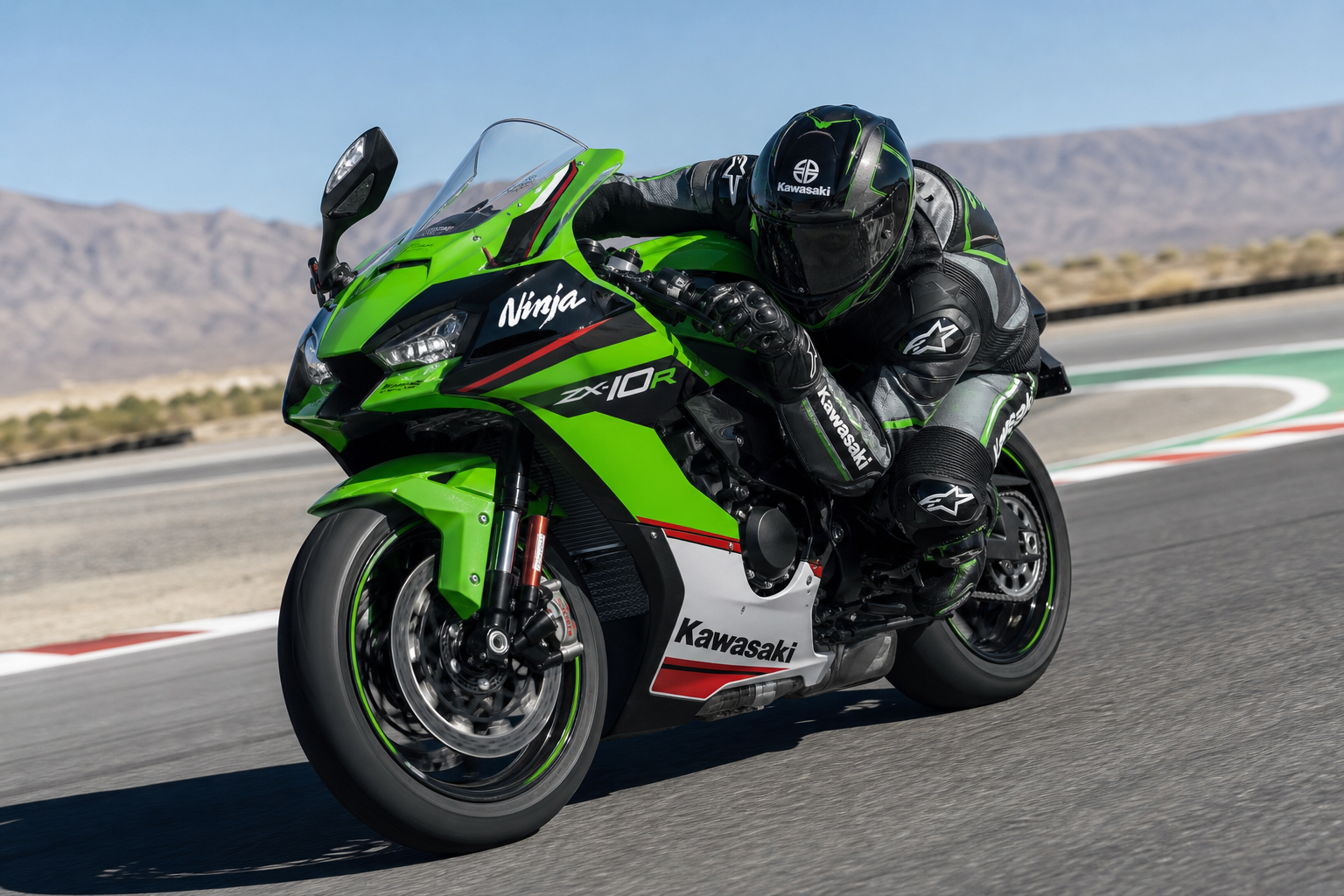
The 2026 Kawasaki Ninja ZX-10R is a focused update rather than a reinvention. Kawasaki kept the liter-class pedigree but refined aerodynamics, chassis geometry and electronics to deliver faster, more stable lap times while remaining useable on the street. This review combines factory figures, independent dyno reports and track reporting to give a practical, technical look at what changed and what matters to riders.
WHAT KIND OF STORY IS THIS BIKE TELLING?
Short answer: it’s a model review. Kawasaki’s 2026 ZX-10R continues the brand’s WorldSBK-derived approach: racetrack capability first, road manners second. The updates aim to convert greater aerodynamic downforce into lap-time gains without making the bike a handful in traffic or on canyon roads.
KEY NUMBERS YOU NEED
Engine: 998cc inline-four with finger-follower valve actuation (factory-stated).
Claimed peak power: 190 hp at around 11,500 rpm; with ram-air pressurization Kawasaki lists closer to 203 PS at speed. Independent dyno samples have shown rear-wheel outputs in the high‑160s to mid‑180s hp range after drivetrain loss.
Claimed peak torque: about 82.5 lb·ft (111.8 Nm) at roughly 11,300 rpm.
Weight: Kawasaki/early reviews put curb weight at roughly 210 kg (463 lb) with ABS and about 208 kg (459 lb) without.
Fuel tank: 17 liters.
Pricing (U.S. territory guidance from Kawasaki): entry ZX-10R shown at about $16,999 (non-ABS base level references exist) with ABS-equipped trims listed around $17,999; the track-focused ZX-10RR sits significantly higher (factory info lists $29,999 for RR in some territories).
DESIGN, AERODYNAMICS AND CHASSIS CHANGES
Visually the 2026 model wears sharper bodywork and integrated winglets up front. Kawasaki reports the winglets increase front downforce and testing notes indicate roughly a 20–25% increase in measured front downforce versus prior versions. To make the new aero work the team revised the swingarm pivot and suspension balance.
The geometry changes are subtle but meaningful: a slightly altered swingarm pivot (reports show a +2 mm vertical change on the pivot), small rake/trail tweaks and a marginally longer wheelbase in stock trim (measured around 1,475 mm on reviewed examples). The goal is a steadier front end under braking and higher-speed stability without deadening turn-in.
ENGINE CHARACTER & PERFORMANCE
The 998cc four retains the screaming top‑end temperament the ZX family is known for while gaining usable midrange. On-track and on the dyno, the motor responds best with the throttle opened cleanly through corners; the electronics and quickshifter are slick and reduce the need for aggressive, clutch-based direction changes.
Ram-air and intake reworking mean peak claims are higher at speed, but real-world rear-wheel figures are lower after loss to the drivetrain—expect the practical usable horsepower to arrive late in the rev range and accelerate strongly from mid-to-high RPMs.
SUSPENSION, WHEELS AND HARDWARE
Front suspension: 43 mm Showa Balance Free Front Fork (BFF) with independent adjustment. The BFF geometry and damping give consistent feedback under braking and allow more aggressive set-ups for track use.
Rear: Showa BFRC-lite rear shock with dual-range high/low-speed compression and stepless rebound adjustment. The unit works with the revised link geometry to tame the extra downforce while keeping rear compliance for street use.
Brakes and wheels: Brembo-style dual 330 mm front discs with radial monobloc calipers and Kawasaki Intelligent anti-lock Brake System (KIBS) across the range. The setup delivers hard, controllable stopping power and excellent modulation—critical when you’re carrying added downforce into a braking zone.
ELECTRONICS SUITE
The ZX-10R’s electronics are refined rather than completely overhauled. Expect multi-level traction control, launch control, ABS with KIBS calibration, selectable engine modes, quickshifter and an on-board lap timer. A clear 5-inch TFT provides ride-mode info, lap timing and some smartphone connectivity features on higher trims.
What to expect on track
On a technical circuit the 2026 ZX-10R nails its brief: it’s more stable at speed, brakes hard without unsettling the chassis, and the added front downforce gives real confidence entering tight, fast corners. The gearbox is crisp; shifts are immediate and the slipper clutch is well-calibrated so rear-wheel hop is minimal under abrupt downshifts.
Mid-range torque makes exiting slower corners easier than previous generations, so you can be more aggressive through mid-gear gears without hunting for revs. The trade-off is that the absolute top-end scream remains a factor—this bike lives at high RPM.
SETUP AND RIDE TIPS FROM A COACH
- Track days: Start with a slightly firmer rear high-speed compression setting and reduce fork rebound a notch from street baseline. The bike likes a confident front contact patch when you’re exploiting the winglets’ downforce.
- Street: Soften high-speed compression and add a click or two to rebound damping for better compliance over rough surfaces. The aero still helps at highway speeds, but comfort is king on long rides.
- Braking: Use progressive front pressure and trail brake into corners. The Brembo calipers reward a firm, linear squeeze—there’s no need to grab wildly; modulation is excellent.
- Tires: Choose a compound appropriate to your primary use—sticky track rubber for circuit days, a more durable sport compound for street commuting. Follow tire and manual pressure guidance rather than guessing numbers.
PRACTICAL OWNERSHIP: MAINTENANCE, COSTS AND OPTIONS
Service intervals, valve checks and consumables remain essential on high-performance literbikes. Kawasaki’s production notes show finger-follower valve actuation and high-rev characteristics—follow the factory manual and dealer service schedule for valve clearance and cam-chain inspections. Parts like a properly bled brake system and fresh brake fluid are non-negotiable if you intend to run the bike hard.
As listed on Kawasaki’s official material, base pricing for US-market ZX-10R trims started in the mid-teens for MSRP in the first shows (factory numbers list models around $16,999 for base presentations and higher for ABS-equipped trims, with the RR at a substantially higher premium). Expect options such as quick-shifter, track-focused ECU mapping, and cosmetic KRT editions to affect final cost.
WHO SHOULD BUY THE 2026 ZX-10R?
If you want a liter-class machine that translates WorldSBK hardware into a production package with real performance gains, this is a strong choice. Riders who spend time on track and demand near-factory aerodynamic benefits will get the most from the updates. Street riders who want occasional track days will appreciate the stronger mid-range and improved braking stability, but should be comfortable with firm suspension when pushed hard.
FINAL THOUGHTS
The 2026 Kawasaki Ninja ZX-10R takes focused, iterative steps forward: more front bite from aero, refined suspension geometry and electronics sharpening the delivery. It’s not a quake-of-change model year; it’s a rider-focused evolution that rewards precision. For sportbike riders who split time between track and spirited street riding, it raises the bar without sacrificing the bike’s core identity.
If you’re shopping, test-ride one in both street and track configurations if possible. Pay attention to suspension settings and tire choice—the ZX-10R gives back exactly what you put into setup and inputs.


0 Comments