

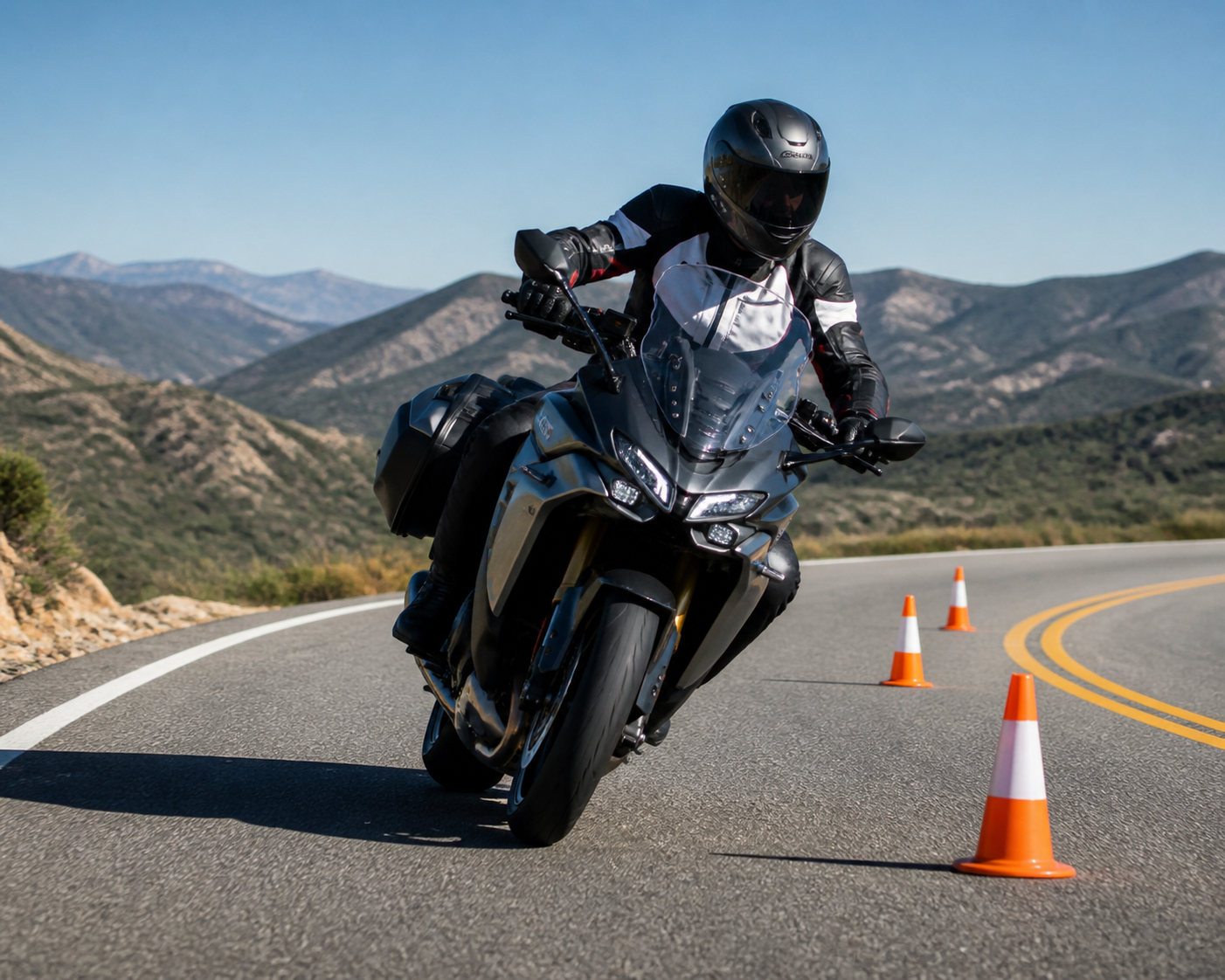
Why Defensive Riding Still Wins in 2026
Technology on bikes has advanced, but real-world survival still comes down to the rider. Electronic aids help, but they do not replace quick judgement, practiced technique, and muscle memory.
Traffic density is higher. Vehicle driver distraction is unchanged. That makes occupying the right space and reacting cleanly more valuable than ever.
Core principles every rider must master
Time and space management are the foundation. Keep usable escape room around your bike: front, side and behind.
Scan early and wide. Move your eyes to the next potential hazard, then the one after that. Short, frequent glances let you detect trouble before it becomes critical.
Control speed to match risk. A controlled 10–15 km/h reduction through cluttered areas buys you more reaction time than any electronic feature can.
Understand what you’re working against: perception and stopping physics
Your brain and body take time to register and react. Typical alert riders show a perception-reaction time around 0.75–1.0 second in many studies, with longer times under fatigue or surprise.
That delay eats distance fast. Practical stopping benchmarks used by safety authorities and rider tests put a 60 km/h emergency-stop roughly in the mid-30 metre range on dry pavement under ideal braking — expect variation with rider input, tires and pavement quality.
At 50 km/h many measured stops land around 20–30 metres; at 100 km/h total stopping distance jumps past 70 metres in real-world tests when perception and reaction are included.
Emergency braking: threshold braking vs ABS
Learn both. Threshold braking is the technique of applying maximum brake force without locking the wheel. Trained riders can stop hard using this method, but it requires repeat practice and calm hands.
ABS prevents lock-up and maintains steerability under extreme braking. Road-safety analyses indicate ABS can reduce stopping distance and, crucially, reduce crash rates in real traffic — some agency data suggests up to about a 15–20% reduction in stopping distance in many scenarios. In high-traction, perfectly timed threshold stops a skilled rider may match or better ABS numbers, but that’s not a reliable plan in traffic.
Practical drill: On a closed surface, practice progressive front-brake pressure until the suspension compresses and the front tire contact becomes stable — then back off the last few percent. Build this at low speeds first, then move to 50–60 km/h with a coach or partner for feedback.
Brake-and-swerve: how to pick the right response
When something appears suddenly, you have three options: brake in a straight line, swerve around it, or a combination. Pick by available space and surface condition.
If you have clear, paved escape lane and adequate speed differential, countersteering and a decisive swerve is often fastest to avoid the hazard. If you’re boxed in, a controlled emergency stop is safer.
Key point: don’t lock the front wheel. A locked front wheel kills steerability and usually ends the ride. If ABS is active, apply firm, sustained pressure and steer through the maneuver — ABS will modulate; you keep vision and line.
Countersteer, commitment and foot position
Countersteer is simple in theory: push the bar in the direction you want to go to initiate lean. In practice it needs commitment — half-hearted inputs cause wobble and indecision.
Feet should be firmly on the pegs during high-speed avoidance; toes down invites panting anxiety and weakens leverage. Grip the tank with knees. Relax your shoulders and breathe.
Low-speed escapes and tight-space maneuvers
At walking-to-25 km/h speeds, clutch and throttle modulation are king. Practice controlled rear-brake slides for very tight turns and learn to ride the friction circle — small throttle blips will shift weight and traction enough to steer without full steering lock.
Bike setup that supports defensive riding
Tires are the single biggest influence on braking and cornering. Dry peak friction coefficients for modern road tires are often around 1.0–1.2 in tests; wet grip will be considerably lower. Replace tires before tread or age degrade performance.
Brakes and suspension must be maintained. Spongy lever feel or a soft pedal is a warning; bleed lines and correct pad choice restore consistent bite. Set suspension to support firm weight transfer during heavy braking — too soft and you lose geometry, too harsh and you reduce contact patch compliance.
Daily checklist before every ride
Look and feel: tires, brake response, throttle smoothness, lights and mirrors.
Mental check: one-line commitment. Visualize escape routes for the first few corners and set your initial speed to default conservative.
Training plan: build the skills that save you
Week 1 — Foundations: slow-speed balance, clutch/feather work, tight U-turns and figure-eights for six sessions.
Week 2 — Braking basics: progressive front-brake drills, combined brake-and-clutch stops, 30–50 km/h emergency stops, ride with a partner and record times.
Week 3 — High-speed avoidance: controlled countersteer practice at 50–70 km/h on a closed course, swerve lanes with cones, then add a braking element.
Ongoing — Pressure practice: once per month, repeat emergency stops and swerves with a coach; once per season, practice on a wet surface to learn how reduced traction changes inputs.
Real-world scenarios and quick scripts
Urban: assume every side street hides a blind vehicle. Reduce speed, move to a position where you can see further down the side street, and keep one escape lane free.
Highway: never ride in blind spots for long. If a car cuts you off, make a single, decisive move — squeeze brakes to warn and a lane change if clear. Keep following distance two to three seconds or more.
Wet or debris: downshift early, lighten braking inputs, and use both brakes progressively. Expect braking distances to increase greatly; plan an exit before the hazard arrives.
Mental game and habit formation
Practice calm. Panic short-circuits everything. Rehearse responses in a quiet parking lot until the correct motor patterns are automatic: sight, select, act.
After any near-miss, do a short ride debrief: what you saw, why you chose the response, and one concrete tweak you’ll make next time.
Putting it together — a sample emergency reaction sequence
1) Spot the threat. Eyes move to the hazard and first escape lane. 2) Commit a one-line decision: swerve or stop. 3) If stopping — strong, progressive front brake; clamp knees, look up, and set body weight rearward slightly. 4) If swerving — decisive countersteer, throttle neutral, eyes to your exit. 5) Recover to safe speed and reassess.
Final notes on equipment and legal considerations
Invest in certified protective gear and keep documentation for maintenance—both will matter after a crash. Practice within legal confines and on closed ranges when introducing risky drills.
Defensive riding is a skillset you earn through repetition and honest feedback. The rider who trains deliberately, maintains their machine, and respects physics will outlive luck every time.


0 Comments