

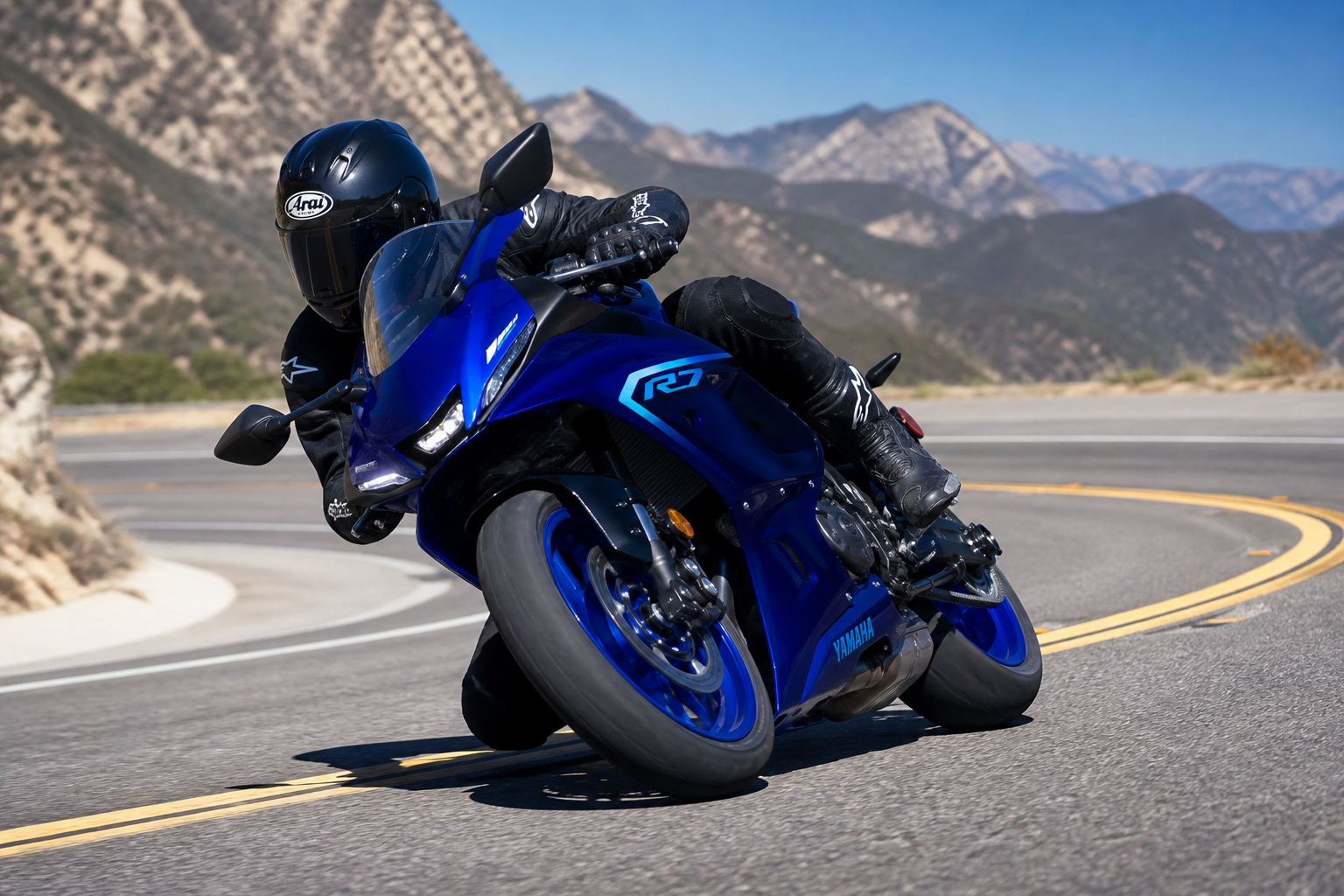
INTRO — WHAT THIS REVIEW COVERS
This is a focused model review of the 2026 Yamaha YZF-R7. The goal: lay out the verified specs, explain what they feel like on the seat, and show how the new R7 fits into a rider’s life—street or track.
SPECIFICATIONS AT A GLANCE
- Engine: 689cc liquid-cooled CP2 parallel twin, DOHC, 4-valves per cylinder.
- Claimed output: 72.4 hp (73 PS) @ 8,750 rpm; Peak torque: 50 lb·ft (67.4 Nm) @ 6,500 rpm.
- Measured (rear-wheel): Cycle World dyno ~66.3 hp / 45.7 lb·ft (instrumented test results reported).
- Transmission: 6-speed with Assist & Slipper clutch; third-generation Quick Shift System (QSS).
- Chassis / Dimensions: Wet weight ~417 lb, wheelbase 54.9 in, seat height 32.7 in, rake 24.0°, trail 3.6 in.
- Fuel: 3.7 gal tank; claimed fuel economy ~59 MPG.
- Suspension: 41mm KYB inverted fork (adjustable compression, rebound, preload); linked Monocross rear shock (adjustable preload, rebound).
- Brakes / Wheels / Tires: Dual 298mm front discs with Brake Control System & ABS, 245mm rear disc; Bridgestone Battlax Hypersport S23 — 120/70ZR17 front, 180/55ZR17 rear; Yamaha SpinForged wheels.
- Electronics: YCC-T throttle-by-wire, 6-axis IMU, multiple ride modes, cruise control, traction control and advanced brake control.
- MSRP (U.S.): $9,399; 70th Anniversary edition $9,699 (availability from early 2026).
ENGINE CHARACTER AND PERFORMANCE
The CP2 motor is familiar and it remains the R7’s strong suit. Peak power arrives in the upper midrange but torque comes earlier than you’d expect from a supremely tractable twin. On the road that means immediate roll-on for passing and a flat torque band that keeps the bike lively without needing to chase rpm.
On the dyno front, instrumented testing reports roughly 66.3 hp at the rear wheel, which matches the bike’s on-ride personality: strong, usable acceleration rather than explosive top-end rush. If you want a wide power spread that makes both commuting and track laps efficient, this motor delivers.
ELECTRONICS YOU CAN TRUST
Yamaha has packed the R7 with next-level aids: a 6-axis IMU brings lean-sensitive ABS and traction control to life, while throttle-by-wire (YCC-T) smooths transitions and enables precise ride modes. The addition of a third-generation Quick Shift System changes the feel—upshifts and downshifts are faster and markedly less intrusive to the chassis.
The QSS engages under real-world parameters: it operates above roughly 9 mph (15 kph), with upshifts above about 2,000 rpm and downshifts above 1,600 rpm, which makes both hard accelerations and aggressive deceleration gear changes far cleaner. There are four street modes—Sport, Street, Rain, Custom—and track modes that let you tailor ABS and rear ABS intervention.
CHASSIS, SUSPENSION AND HANDLING
Geometry and component selection give the R7 a distinct personality: nimble and communicative. The 54.9 in wheelbase and 24° rake balance stability with turn-in agility. The KYB 41mm inverted fork provides a solid front-end feel; it’s responsive to rider inputs and gives confidence under braking.
Yamaha’s SpinForged wheels cut rotating mass—Yamaha claims a few percent reduction versus conventional cast wheels—which is noticeable. Direction changes are clean; the R7 doesn’t fight you. On a mixed session of canyon and short circuit laps, the bike responds quickly to line changes and holds a steady mid-corner attitude when the suspension is set up correctly.
BRAKING, FEEL, AND SAFETY SYSTEMS
Stopping hardware is serious for the class: dual 298mm front discs with four-piston calipers and a linked Brake Control System give strong bite and consistent feel. The ABS is lean-sensitive thanks to the IMU, so intervention is less abrupt when you trail-brake into an incline or lean angle.
Practically, that means you can brake later than you might on a non-IMU bike without sudden lock-up. Use progressive application, keep a little trail-brake into the turn, and let the slipper clutch absorb over-rev on aggressive downshifts—the combination of hardware and electronics is forgiving but responsive.
ERGONOMICS, DAILY USABILITY, AND RANGE
Seat height is a moderate 32.7 in, which keeps the R7 accessible to a broad range of riders. The riding position is sport-biased but not extreme; you can commute without chronic discomfort. Cruise control is a welcome addition for longer stretches at highway speeds.
With a 3.7-gallon tank and Yamaha’s claimed 59 MPG, expect a practical range in the low 200s miles under normal riding—real-world factors will vary, but you won’t be hunting for fuel after a long day’s ride.
WHO THIS BIKE IS FOR
If you want a modern, electronic-rich sportbike that behaves on the street yet is competent on the track, the 2026 R7 is a clear candidate. It’s aimed at riders who value predictable power delivery, cutting-edge rider aids in a compact package, and a price that undercuts many full-blown supersport machines.
It’s especially strong for: new-to-intermediate riders stepping up to a more capable machine, experienced riders who prize low-weight agility for canyon runs, and track-day regulars who want a platform that’s easy to tune with aftermarket suspension and track tires.
OWNERSHIP CONSIDERATIONS
- Setup: Invest in a professional suspension setup if you plan regular track days; the KYB hardware responds well to tuning.
- Tires: Stock Bridgestone Battlax S23s are ideal for mixed use; swap to a track compound for serious lap times.
- Maintenance: The CP2 is proven; routine servicing keeps it sweet, and the Assist & Slipper clutch reduces fatigue under aggressive use.
FINAL ASSESSMENT
The 2026 YZF-R7 is a measured evolution. Yamaha kept the proven CP2 heart but raised the electronics and chassis specification to create a package that feels modern and capable without overwhelming recreational riders. It’s not the most powerful bike on the market, but it’s one of the most usable and confidence-inspiring in its price band.
If you want a sportbike that you can ride hard on public roads and still take to the track with minimal surprises, the R7 is tuned toward that sweet spot.


0 Comments