

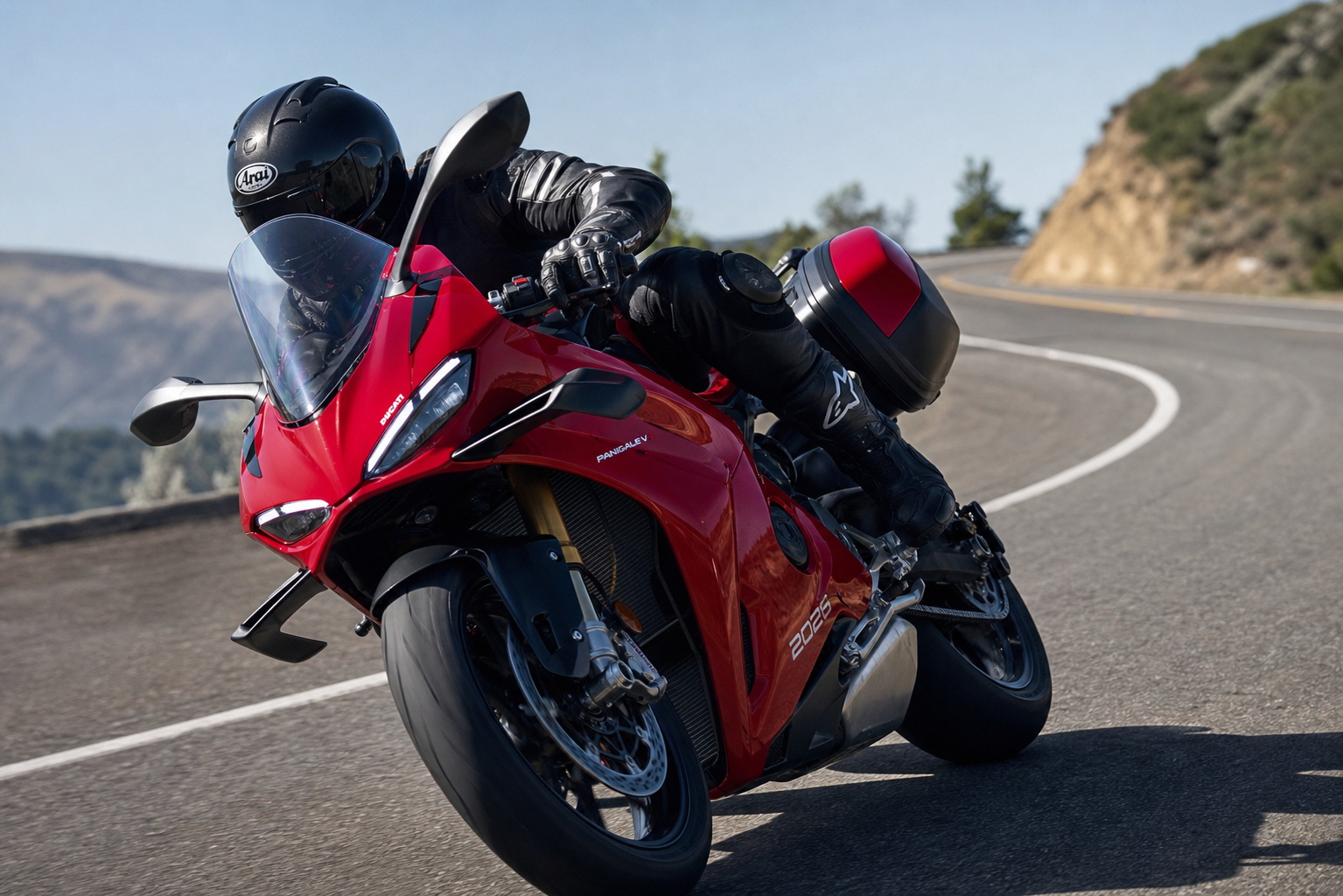
WHY ADVANCED CORNERING IS NON-NEGOTIABLE IN 2026
Motorcycles are faster, street speeds and traffic complexity are higher, and electronic aids mask—but do not remove—fundamental skill gaps. I see riders on modern machines out-braking the limits of tire grip because they trust systems they don't understand. The difference between arriving upright and making an expensive mistake is often in how you enter, manage, and exit a turn.
WHAT “ADVANCED CORNERING” ACTUALLY COVERS
This isn’t about theatrics. It’s about three linked skills: precise line selection, managing the bike’s pitch and weight transfer, and controlling traction through modulation of brakes and throttle. Put those together and you ride faster, with more margin for error, and with far less fatigue.
KEY PHYSICS YOU MUST FEEL — NOT MEMORIZE
Countersteer remains the initiation method for every meaningful lean angle. Push on the inside bar to make the bike want to tip, then work the grip and shoulders to shape the turn. As you lean, the tire contact patch reshapes; traction is a vector that must be shared between braking, turning, and driving forces. Riders train to trade those forces deliberately.
Real-world context: professional racers routinely reach extreme lean angles—MotoGP machines achieve more than sixty degrees of lean in competition—while rider comfort and initial instincts often sit much lower. Training expands what you can reliably call “safe lean” under different conditions.
THE PROGRESSION: HOW TO TRAIN THIS WEEK-BY-WEEK
Mastery is incremental. Here’s a proven four-week progression you can run on quiet roads, parking lots, and a closed track.
- Week 1 — Fundamentals on a parking lot: slow-speed countersteer drills, figure-eights, quick releases of brake to feel the bike’s balance.
- Week 2 — Mid-speed lines: practice single apex turns at 25–40 km/h, focus on head and sight line; carry a steady throttle through the exit.
- Week 3 — Introduce trail braking: short sections of controlled front-brake tapering as you enter a shallow corner, then progressively increase lean once comfortable.
- Week 4 — Link and refine: string multiple corners; vary entry speed and create contingency plans for unexpected changes in surface or traffic.
DRILL: COUNTERSTEER AND SIGHTLINE
Find a large, empty lot. Accelerate to a moderate speed where a short press to the inside bar produces a measurable lean. Repeat until the countersteer input is smooth and immediate. Keep your eyes on the far exit—your hands will follow your head. This simple drill rewires steering inputs into deliberate, efficient movements.
CONTACT PATCH & TIRE FEEL — WHERE GRIP LIVES
Tires don’t provide infinite grip. The patch shape and pressure change as you lean and load the tire. The sensation of grip loss is subtle at first: a muted steering response, a slight drift. Train to back off gently and reestablish a clean traction vector.
BODY POSITION: SMALL CHANGES, BIG RESULTS
Body work is not a fashion statement. Move your head to the inside of the turn, slide your butt off the seat slightly, and keep your outside elbow down and relaxed. This reduces the bike’s roll angle for the same cornering speed and helps you keep more tire contacting useful surface. Keep your inside knee pointed toward the apex—not jammed out like a spectator pose.
TRAIL BRAKING: STEP-BY-STEP
Trail braking lets you shape entry speed and corner radius with one continuous input rather than two abrupt changes. Done right, it buys you both safety and options; done wrong, it unsettles the chassis.
- Approach: Set your entry speed using both brakes while the bike is upright.
- Initiate: Just before turn-in, maintain front brake pressure but begin a smooth, deliberate taper—don’t snap it off.
- Commit: As you feel the front end settle and the line is confirmed, finish brake release and apply slight throttle to balance the bike.
- Recover: If the front wants to push wide, lighten the braking, get more weight to the front, and tighten the line via body position rather than further braking.
Practice this on progressively sharper corners and always under controlled conditions. You’ll know you’re improving when you can change your entry radius mid-corner using subtle brake tapering and body inputs.
USING ELECTRONICS WITHOUT LETTING THEM DO THE THINKING
Traction control and cornering ABS are fantastic when they work—but they can also hide bad habits. Learn the technique first with systems on at stock settings. When you progress to a track environment, reduce assistance one step at a time so you understand what the bike is doing without being rescued.
COMMON MISTAKES AND SIMPLE FIXES
Rushing the turn-in: Slow your thoughts and speed. Visualize the apex and wait one beat before committing.
Gripping the bars: Relaxed hands improve feel. If you’re squeezing, check your shoulder position and breath rhythm.
Over-braking late: Use initial speed management—trail braking is about tapering, not scaring the front end into a grab.
SETUP CHECKS BEFORE YOU TRAIN
Always confirm basic setup: correct tire pressures to manufacturer spec, roadworthy tires with even wear, and firm but not over-tight controls. Small set-up faults can masquerade as technique problems and slow your progress.
A SAMPLE 90-MINUTE SESSION PLAN
Warm-up (15 minutes): parking-lot countersteer and sightline drills.
Core work (45 minutes): figure-eights, single-apex entries, progressive trail-braking intervals.
Cooling (15 minutes): relaxed rides focusing on smooth lines and breathing.
Review (15 minutes): notes on what felt right, what surprised you, and the next session’s focus.
MEASURING PROGRESS
Progress is less about speed and more about consistency: smoother entries, fewer corrections mid-corner, and increased confidence to change line if needed. Record short video of your line from multiple angles and compare run-to-run. Small technical gains compound quickly.
FINAL NOTE FROM THE SADDLE
If you want to be a safe, fast, and reliable rider in 2026, invest in measured practice. Cornering is not a secret; it’s a craft. Treat it that way—structured sessions, honest feedback, and steady repetition. The bike will reward you with stability, speed, and the best kind of confidence: earned.


0 Comments