

I write this from years in garages, on racetracks and out on long highway runs. 2026 feels different. The machines arriving now change what a motorcycle can do for range, for safety and for how a rider works with the machine. This is a field report on the practical tech you will see in showrooms and on streets this year.
SIGNATURE SHIFT: WHY 2026 MATTERS
This year the industry moved past incremental upgrades. We’ve hit major system-level changes: battery chemistry that shrinks charge time, sensors that watch for threats around the bike, suspension that adapts without a wrench, and cockpit tech that keeps your eyes forward. Some advances are proven in limited production; others are rolling into mainstream models fast. I’ll separate claims from real-world impact and tell you what matters on the road.
1) SOLID-STATE BATTERIES — A PRACTICAL GAME CHANGER
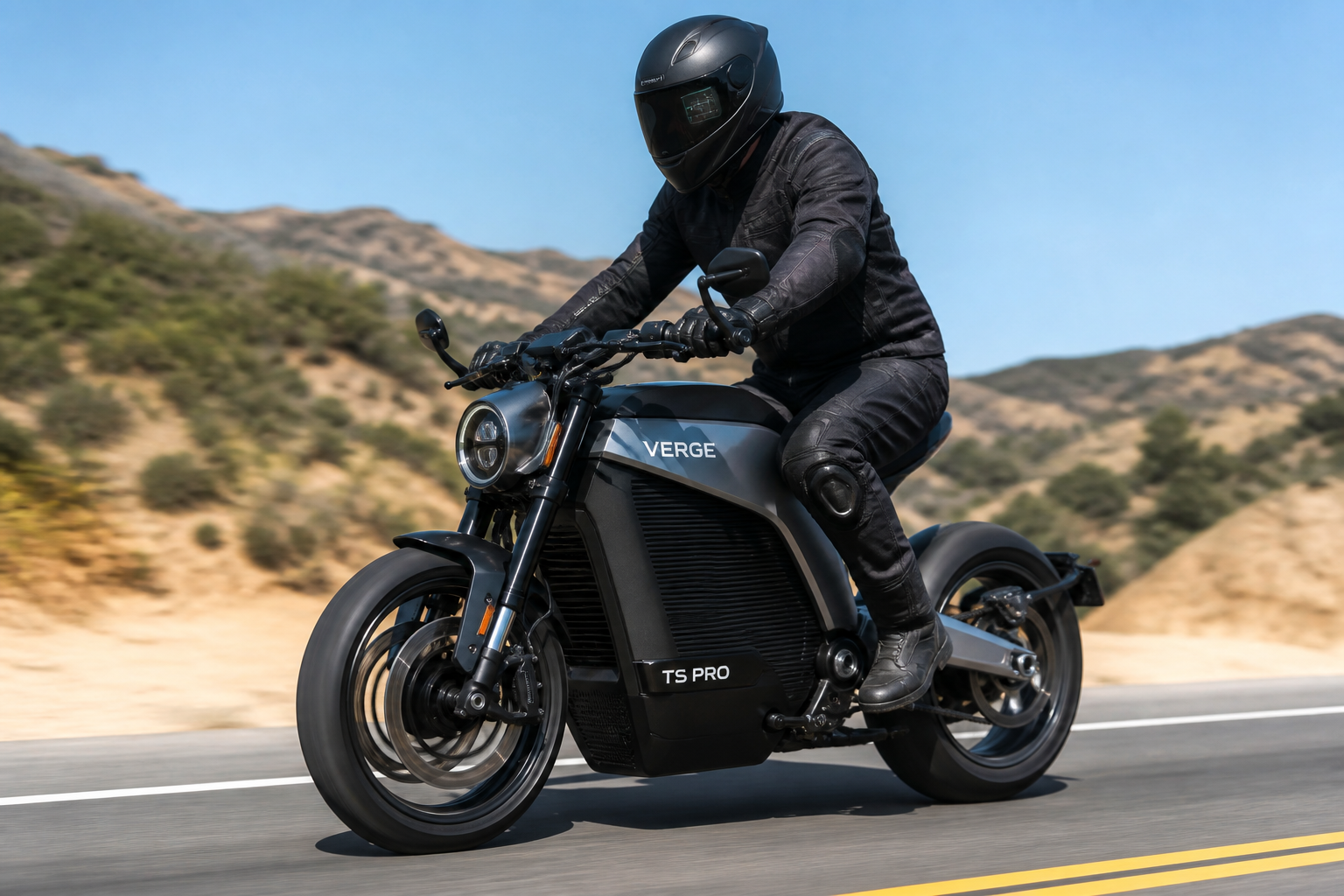
Who’s shipping it: Verge Motorcycles partnered with Donut Lab to introduce a production motorcycle using solid-state cells. These packs are being offered in two capacities and are already in customers’ pre-orders.
What the tech promises: Donut Lab and Verge state the larger pack for the Verge TS Pro is 33.3 kWh with a claimed combined-range figure near 370 miles (from Verge/Donut Lab press materials). Donut Lab showed a cell-level figure around 400 Wh/kg and aggressive fast-charging capability — a cited peak charging rate that can recover a large amount of range in minutes, with company demos claiming back-to-80% times measured in the low tens of minutes using high-power chargers.
Why that matters to riders: if those numbers hold in mixed riding, electric bikes become viable for long touring without long pit stops. Batteries that tolerate many more cycles also cut lifetime cost and reduce degradation anxiety for daily riders. But buyer caution is warranted: these are new chemistries in low-volume production. Expect real-world range to vary with speed, temperature and riding style.
2) RADAR-BASED ADVANCED RIDER ASSISTANCE (ARAS)
Bosch’s latest motorcycle radar suite is live in production programs and is the blueprint many OEMs will follow. The system combines a front and rear radar with the IMU and ABS/MSC systems to deliver features like adaptive cruise control that can bring a bike to a controlled stop, blind-spot warnings, and automatic short braking pulses to get a rider’s attention.
Key practical details: Bosch publishes that its ARAS functions are lean-angle aware, meaning the electronics adjust allowable intervention based on the bike’s tilt. Bosch also cites safety research suggesting that properly implemented radar assistance could reduce a measurable share of collisions.
Rider takeaway: these systems reduce workload on long rides and intervene quicker than humans in certain scenarios. They are not replacements for defensive riding. Learn how the system alerts you on your specific model and practice with it in low-risk environments so you understand its thresholds and warnings.
3) SMART, ADAPTIVE SUSPENSION — REAL-TIME TUNE
Öhlins and a few other suspension specialists have moved from optional racing bits to fully integrated adaptive damping on production bikes. Öhlins’ Smart EC family adjusts damping in real time using sensors and control algorithms. Honda’s Fireblade SP has shown SmartEC3 hardware in production-level rolling stock, which means the tech is usable in street and track contexts.
Why riders notice it: suspension that changes damping on the fly improves front-end feel on abrupt bumps, resists pitch under heavy braking, and returns comfort at highway speeds — all without manual clicks. For a rider who switches between commuting, canyon work and track days, that adaptability removes the compromise of a single static setup.
4) HUBLESS MOTORS, PACK-INNOVATIONS AND DRIVETRAIN DESIGN
Some startups are experimenting with non-traditional motor packaging, including hubless concepts and compact motor modules intended to allow lower centers of gravity and different frame packaging. Donut Lab’s show demos included unique motor-pack layouts tied to their solid-state modules. These approaches change where mass sits on the machine and how the chassis behaves.
Real-world note: unconventional packaging can improve handling if the mass is low and centralized, but it also changes service access. Ask dealers how major service items are reached before you buy.
5) COCKPIT EVOLUTION: HUDs, CONNECTIVITY AND UX
Heads-up displays and integrated helmet HUD solutions matured in 2026. Companies producing helmet-mounted HUDs now offer clearer daytime legibility and tighter smartphone/instrument integration. Manufacturers are also moving toward OTA updates for ride modes, ABS mapping and navigation.
Practical guardrails: HUDs keep important info in your line of sight, but they must be configured conservatively. I recommend disabling nonessential overlays while learning to use a new system. Keep firmware updates on your schedule and check release notes — some updates alter ABS or traction-control intervention and you should test changes in a safe place.
6) THE IDEA OF STEER‑BY‑WIRE FOR TWO WHEELS
Steer‑by‑wire has entered the mainstream in automobiles, but its motorcycle equivalent is still experimental. Cars such as the 2026 EQS show how by‑wire steering can free designers; motorcycles introduce different challenges due to rapid weight transfer and direct rider input. For now, expect advanced electronics around throttle and braking to continue evolving faster than full steer‑by‑wire on production bikes.
That said, the systems we already trust — ride-by-wire throttles, quickshifters and torque-controlled traction systems — are getting smarter and safer. They form the backbone that would make a steer‑by‑wire system feasible in the future.
PRACTICAL ADVICE FOR RIDERS BUYING INTO 2026 TECH
- Validate warranties: New battery chemistries need clear warranty terms. Check cycle-life and capacity retention guarantees.
- Dealer competence: Choose dealers trained on the new systems. Radar calibration, battery service and adaptive suspension tune-ups require factory tools and software access.
- Learn the limits: Test systems in low-risk settings. Understand how ARAS warns you, when it will intervene, and how to disengage unwanted assistance.
- Software hygiene: Keep firmware updates current but read the changelog. Some updates are safety-critical, others are UX tweaks you may want to delay until tested by early adopters.
- Battery care: For high-energy chemistries, avoid prolonged full charges at high temperature. Follow manufacturer charging recommendations to get the best longevity.
MAINTENANCE & SERVICE REALITIES
New tech shifts service patterns. Expect more software diagnostics and fewer simple plug-and-play fixes. Brake pads, chains and tires are still mechanical items you’ll inspect the same way. Anything tied to battery or radar will require authorized service for safe recalibration.
WHAT I’VE SEEN ON THE ROAD
Adaptive suspension can transform a mixed-use week: it makes highway slop manageable and gives confidence when the pace picks up. Radar-based warnings prevented close calls in urban testing when a distracted driver clipped the curb. Solid-state claims look promising on paper and at trade shows — the next step is long-term owner data to confirm durability under thousands of real-world cycles.
BUYER CHECKLIST
- Ask for measured, independent range tests at speeds you will ride.
- Confirm fast-charge network support and peak charging rates your local infrastructure can deliver.
- Request a demo of ARAS functions and test their alerts at parking-lot speeds.
- Compare suspension modes and whether manual tuning is still available.
- Get clear answers on software update policy, costs and rollback options.
FINAL THOUGHTS FOR RIDERS
2026 is the year multiple systems matured at once. That means higher capability but also higher complexity. The practical rider wins by learning the limits of the tech, insisting on factory-trained service, and buying machines whose new features match the way they ride. If you want long highway miles without long stops, solid-state will be the headline. If you want reduced fatigue and safer commuting, ARAS and adaptive suspension will pay dividends in the first season.
Ride to your strengths. Use the new tools. But keep the basics — line, speed control, and hazard anticipation — as your primary safety systems.


0 Comments