

The 2026 model year pushed motorcycle tech in two directions: radical electrification and practical, rider-focused systems that change how you use the controls. Below I pick five production or near-production bikes that actually move the needle this year — machines you can test-ride, spec-check, or reserve. Each entry names the innovation, explains real-world benefit, and lists verified tech figures so you can judge for yourself.
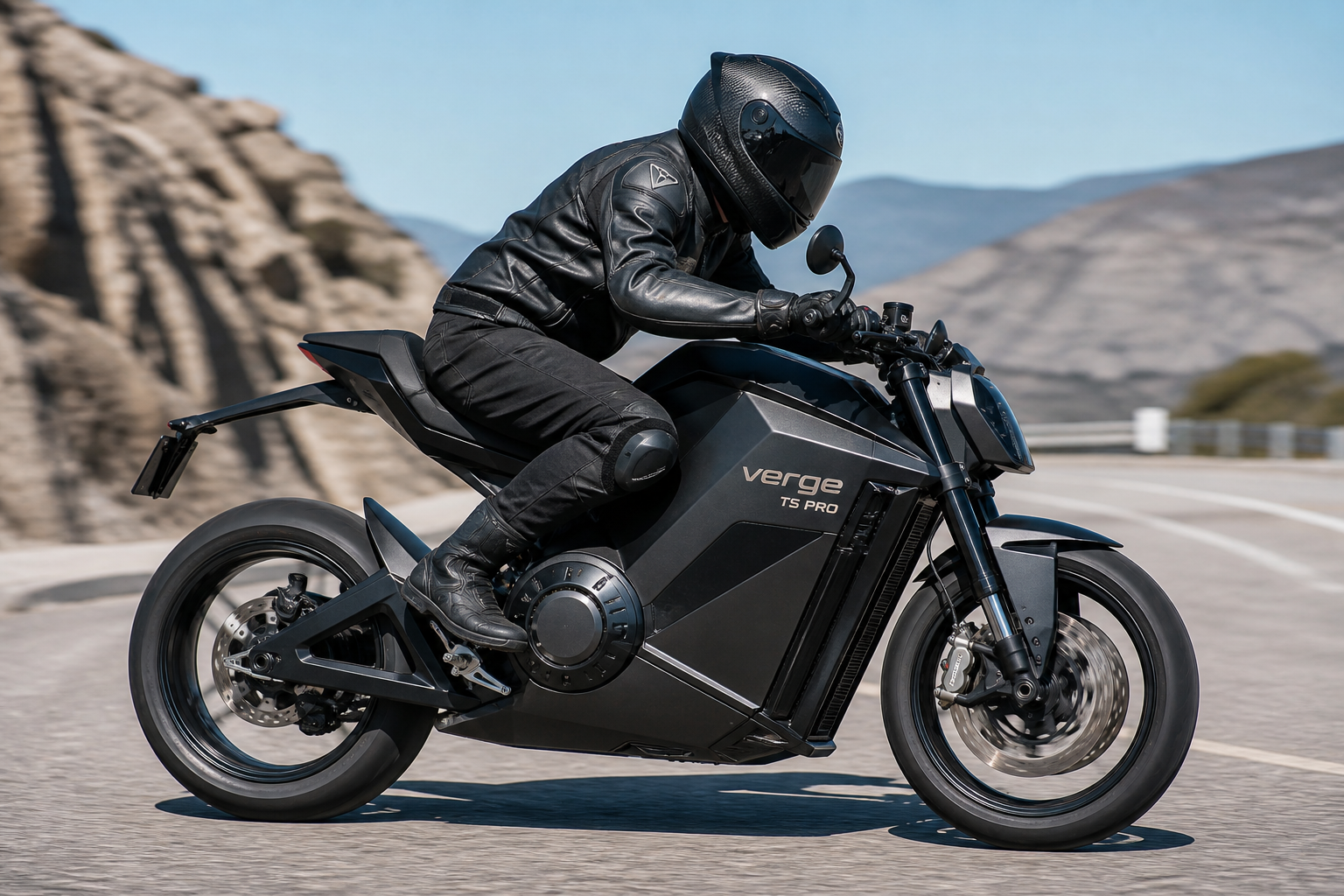
1. Verge TS Pro — Solid‑State Battery and High‑Power Charging
Verge made the headlines by shipping the first motorcycles equipped with a commercial solid‑state battery. The headline figures are breathtaking on paper: a standard pack at about 20 kWh (17 kWh net) with ~350 km range and a long‑range pack option at 33 kWh (30 kWh net) claiming up to ~600 km per charge. Charging hardware supports very high power, with Verge advertising up to 100 kW peak for the standard pack and 200 kW for the long‑range unit.
What this means on the road: dramatic range for long rides, and charging sessions that move from nuisance to short stops. Solid‑state chemistry also brings thermal and safety advantages over conventional lithium designs — less swelling, tighter packaging, and faster, repeatable fast‑charge behaviour when the system is validated.
- Battery: 20 kWh (17 kWh net) / 33 kWh (30 kWh net)
- Charge Peak: ~100 kW / 200 kW (platform dependent)
- Ride Electronics: OTA updates, multiple ride modes, HMI integration
2. Honda XL750 Transalp E‑Clutch — Clutchless Control That Still Feels Like Riding
Honda’s E‑Clutch arrived on multiple 2026 models, and the XL750 Transalp E‑Clutch is the clearest example of tech applied where it matters. The system allows you to start, stop, and change gears without using the clutch lever while keeping a conventional gearbox and the option to use the lever if you want full manual feel.
On an adventure bike, the payoff is real. You get easier slow‑speed control, less left‑hand fatigue on long days, and the ability to manage rear‑wheel slip in technical terrain without losing the mechanical simplicity of a chain drive and six‑speed gearbox. Honda keeps protective details too: the Transalp’s under‑tray and bash plate have been beefed up to protect the E‑Clutch assembly for off‑road use.
- Engine: 755 cc parallel‑twin
- Clutch: Wet multiplate with Honda E‑Clutch
- Suspension Travel: Front ~7.9" / Rear ~7.5"
- Front Brake: Dual 310 mm discs
3. Brabus x DAB Motors — Premium Electric Platform with Urban Performance
The Brabus partnership with DAB Motors delivers a family of electric bikes built around a compact, high‑voltage architecture. These machines are notable for using a 72‑volt architecture with a 7.1 kWh battery in the production Urban E variants, a package aimed at high urban performance and rapid city charging.
Despite modest battery capacity by sport‑bike standards, the platform is tuned for instant torque and everyday usability. Brabus styling and carbon trim add a luxury layer while DAB’s modular motor architecture gives surprisingly strong numbers in the street legal envelope: peak power figures in the mid‑20 kW range and urban ranges around ~93 miles in mixed city use.
- Battery: 72 V, ~7.1 kWh (nominal / max depending on spec)
- Power: 23–27.6 kW depending on model variant
- Range: ~93 miles (city estimate)
- Top Speed: ~75 mph (model dependent)
4. KTM 990 RC R — Full‑Size Sportbike with Modern Electronics and a New LC8c Engine
KTM’s return to a full‑sized sportbike produced a machine that pairs an evolved LC8c powerplant with a focused chassis and advanced electronics. The 990 RC R’s engine displacement is roughly 947 cm³, with peak output reported around 127.8 PS and torque near 103 Nm. What sets the bike apart is how KTM packages performance: adjustable ergonomics, track‑oriented geometry, and electronic aids tuned for aggression.
For riders who want a factory track bike that still fits a commute, the RC R gives adjustable ABS/traction interventions, multiple rider modes, and BIMOTA‑style attention to weight distribution. The result is a usable street bike that feels immediate and accurate on tarmac but still capable of rapid laptimes with minimal setup changes.
- Displacement: 947 cm³
- Power: ≈127.84 PS
- Torque: ≈103 Nm
- Focus: Track geometry, adjustable controls, advanced rider aids
5. Hero MotoCorp + Valeo ARAS Concepts — Radar and Camera Assistance for Commuters
Not every breakthrough arrives as a headline performance part. Hero’s 2026 MoU with Valeo brings automotive‑grade radar and smart cameras into mass‑market two‑wheelers. The Advanced Rider Assistance Systems (ARAS) concepts demonstrated at CES include practical features such as Blind Spot Detection, Forward Collision Warning, and intelligent camera processing tailored to motorcycles and scooters.
This is important because it changes the safety baseline on commuter bikes. Instead of waiting for premium segments to trickle tech down, Valeo and Hero aim to embed driver‑assist style sensors into high‑volume platforms — including Hero’s Vida EV portfolio. Expect systems that warn riders of overtaking vehicles, detect imminent collisions, and augment rider situational awareness without replacing rider control.
- Primary tech: Radar + smart camera fusion
- Functions shown: Blind Spot Detection, Forward Collision Warning, smart camera processing
- Target: Entry and premium segments, including electric scooters
How these technologies change real riding
Solid‑state batteries make long rides with short charging stops plausible. Clutchless systems like Honda’s E‑Clutch reduce rider workload in traffic and technical terrain. Compact urban electrics push usable city range without expensive charging infrastructure. High‑power sport machines bring modern traction and ABS calibration to extreme performance. And ARAS will start to reduce avoidable commuter crashes by giving riders warnings they didn’t have before.
Practical buying checklist for 2026 breakthroughs
- Validate real shipping status: For radical claims (solid‑state packs, ultra‑fast charging), confirm delivery timelines and warranty coverage before placing a deposit.
- Test the human interface: Try E‑Clutch or rider‑assist systems at slow speeds to confirm behavior matches your expectations.
- Service and software: Check OTA update policy and local dealer familiarity for new battery chemistries or ARAS sensor suites.
- Weight and geometry: New batteries change mass and center of gravity; ride to verify handling in real conditions.
In 2026 the useful edge wasn’t always raw horsepower. Often it was systems that saved effort, extended usable range, or protected the rider. If you’re shopping this year, prioritize verified specs and a solid dealer network — and don’t buy on hype alone. Test the tech yourself; the way it integrates with your riding style is what really matters.


0 Comments