

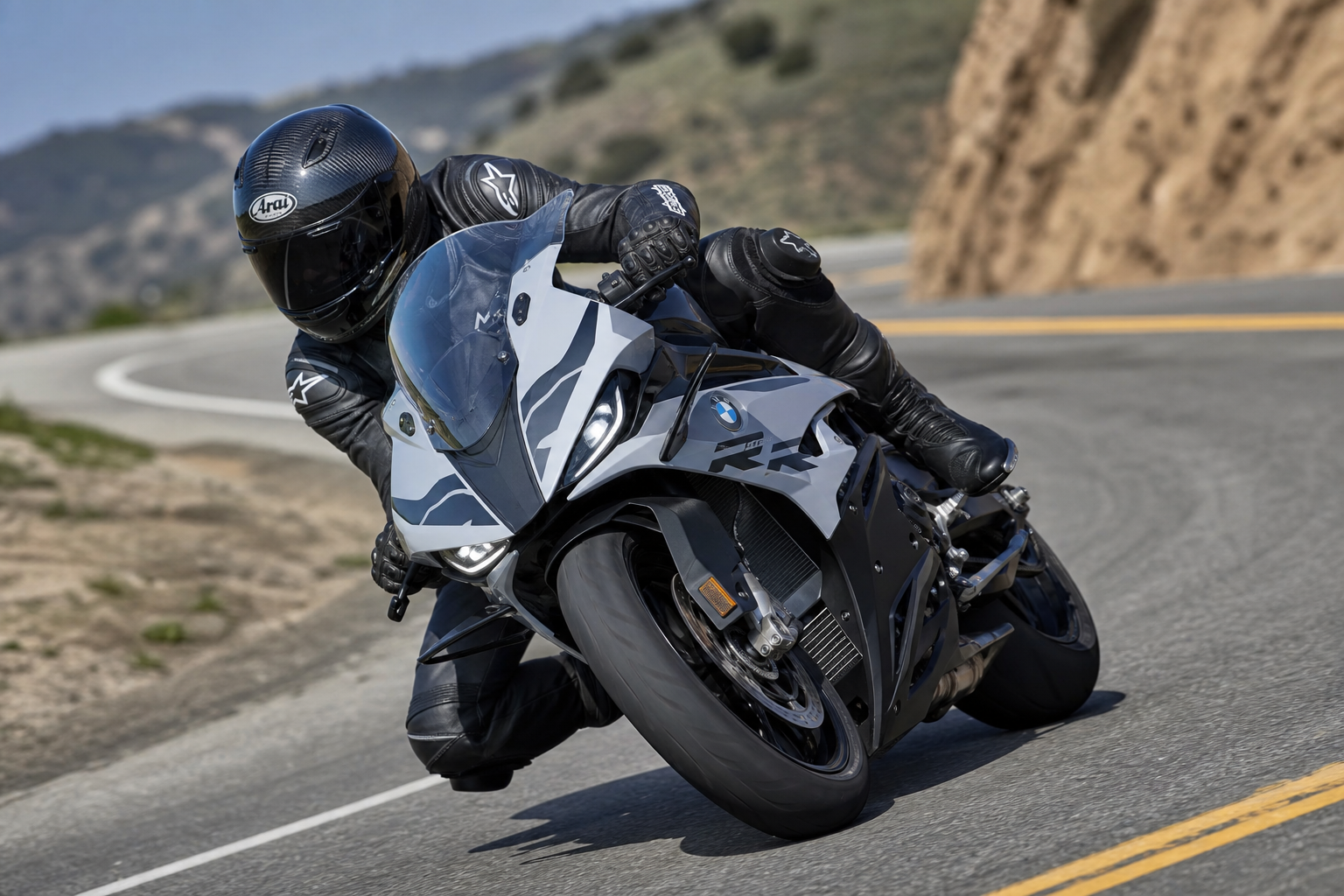
This article is a practical, no-nonsense course in the fine control that separates experienced riders from fast novices. I write from years on racetracks and twisty mountain roads. Expect clear drills, exact cues, and the mechanical reasons behind each move. No fluff. Just riding that works on the street and at the circuit.
WHAT THIS GUIDE IS — AND WHAT IT ISN'T
This is a handling and advanced-rider techniques piece. It assumes you already have competent basic skills: emergency stops, confident lane positioning, and the ability to countersteer at speed. If those are shaky, spend a day with a certified instructor before trying the drills below.
THE FIRST UNSEEN: FORCES YOU FEEL BUT CAN'T SEE
Every advanced maneuver is a conversation with three invisible partners: inertia, tire traction, and gyroscopic precession. Learn to read what they return to you through the bars, seat, and pegs.
Countersteering is the primary entry tool at speed. A short, firm push on the bar toward the turn makes the bike lean. That lean is what lets the tires develop lateral force. Practice a deliberate, low-amplitude push in a parking lot until the action becomes muscle memory.
THE TRACTION CIRCLE: BRAKING, CORNERING, ACCELERATION
Think of the tire’s grip as a finite budget. Spend too much on braking while leaned over and you’ll borrow from cornering grip. Race riders use braking deliberately to reshuffle the budget; street riders must be conservative. The skill is learning how far you can stretch the contact patch without collapse.
Drill: On a safe, low-traffic road, pick a gentle left-right pair of corners. Enter at a steady speed, apply a progressive front brake, then release as you begin to lean. Repeat, reducing entry speed incrementally. The goal: feel the point where the front wants to wash out before it happens.
ADVANCED BRAKING: TRAIL BRAKING THAT DOESN’T FAIL YOU
Trail braking extends braking slightly past turn-in, using the front brake to control pitch and rotational rate. On modern bikes with IMU-enabled cornering ABS, you get a safety net—ABS and stability systems can modulate braking while leaned—but the rider still controls how much load the front tire carries.
Practical cues: keep your shoulders relaxed, brake with the first two fingers, and feel for a steady deceleration rather than a sharp squeeze. As the bike starts to lean, release the brake smoothly and add throttle. That sequence moves the mass forward, then allows the chassis to open the corner when you want it to.
HOW ELECTRONICS CHANGE THE GAME (2026 CONTEXT)
By 2026, cornering ABS and IMU-driven traction control are standard on many mid and upper-tier machines. These systems measure lean, pitch, and yaw to permit limited braking in turns without immediate wheel lockup. They let you practice trail braking with more margin for error, but they don't replace the need for good technique.
Ride-by-wire throttle and multi-level traction control let you tune engine response for practice sessions. Use a softer map when practicing low-traction drills and move to sharper maps only once your inputs are consistent.
WEIGHT, BODY POSITION, AND THE SUBTLE ADJUSTMENTS
Small body moves change the bike’s balance more than you think. Shifting your butt slightly off the seat—inside peg pressure in corners—reduces the lean angle required for the same corner speed. That gives you extra margin for grip while keeping the tires in a healthier part of the traction envelope.
Tip: during high-speed entries keep your head aligned with the horizon and your chin pointed through the corner. Let your upper body follow the bike, but keep elbow pressure light. The goal is a connected, stable chassis—not a rigid robot on the bars.
SMOOTH THROTTLE CONTROL AND SLIP-ANGLE MANAGEMENT
Throttle is steering on a motorcycle. A steady roll-on through and past the apex builds rear traction and sets the bike’s attitude for exit. Abrupt mid-corner throttle changes cause sudden slip-angle shifts and can trigger traction control or a loss of rear grip.
Drill: on a low-traffic twisty road, focus only on throttle consistency. Enter slowly, maintain a steady throttle through the apex, and then apply a controlled increase. Use small increments—your wrist should move like a metronome, not a piston.
LOW-SPEED TECHNIQUES: U-TURNS, TRACK STANDS, QUICK-FootWORK
Low-speed control is where many high-speed failures begin. If you can reliably control clutch slip and rear brake modulation at walking pace, fast entries feel less precarious. Practice tight U-turns with a controlled clutch slip, light rear brake, and eyes looking through the turn.
Track stand practice on a flat piece of pavement builds balance and confidence. Keep the throttle engaged at minimal rpm, use rear brake nibble, and watch for subtle shifts in balance. Wear full gear—even at low speed—every time you practice.
EMERGENCY MANEUVERS: SWERVE AND RECOVER
Two options exist when something appears: stop where you are, or move around it. For a sudden obstacle at speed, an emergency swerve often beats hard braking. The swerve uses a short, assertive countersteer input followed by a steady roll-on to stabilize. Avoid braking hard while leaned and mid-swerve; that splits available grip.
Practice drill: set up cones in a staggered pattern. Approach at a moderate, controlled speed, perform an emergency swerve around the first cone, then immediately perform a controlled stop. That sequence trains muscle memory for detection, swerve, and then stop.
PROGRESSION PLAN: THREE WEEKS TO SYSTEMATIZE THE SKILLS
Week 1 — Foundation: slow-speed clutch, rear-brake modulation, exaggerated countersteer in a parking lot. Repeat until inputs are subconscious.
Week 2 — Medium-speed: basic trail-braking into gentle corners, steady throttle through the apex, and weight-shift drills on a quiet backroad.
Week 3 — Integration: combine trail braking, swerve drills, and throttle management at increasing speeds. Finish each session with a cooldown ride and written notes about what felt different.
SETUP AND MAINTENANCE THAT AFFECT MANEUVERABILITY
Tire pressures and suspension settings alter the bike’s responses more than small riding tweaks. Keep tire pressures within the manufacturer’s street and load specs and check them cold. Small increments in rear preload or compression damping can make the chassis turn-in faster or slower—test changes one at a time.
Brake lever reach and clutch lever feel should be adjusted so you can modulate them with two fingers. If you ride with run-flat or semi-rigid luggage, account for different mass distribution during practice runs.
COMMON MISTAKES AND HOW TO FIX THEM
- Stiff arms: relax shoulders; let the bike do the work.
- Late vision: look where you want to go, not at the hazard.
- Overbraking in the lean: practice progressive release of the front brake as you initiate the turn.
- Relying solely on electronics: use systems as backup, not a crutch.
SAFETY GEAR AND PRACTICE ETHICS
Always wear certified protective gear for advanced practice. A full-face helmet, CE-rated jacket and pants or one-piece leather, gloves, and boots are non-negotiable. Book closed-course time or find an empty industrial lot for the first weeks—do not attempt high-risk drills in traffic.
MEASURING PROGRESS
Keep a short training log. Note times, speeds, conditions, and what input changed. Small, measurable improvements—like consistent apex speed or fewer mid-corner corrections—mean you’re absorbing the technique.
FINAL PRACTICAL CHECKLIST BEFORE A SESSION
- Tyre pressures checked cold.
- Brakes free of drag and pad thickness verified.
- Suspension set to a known baseline.
- Full protective gear on and zipped.
- Phone off or in aero mode; training partner informed of location.
Good technique comes from deliberate, repeated practice and humility. The unseen forces will always be there, but once you learn to read and influence them, riding becomes smoother, faster, and safer. Take your time, respect the machine, and the margin you gain will reward you every ride.


0 Comments