

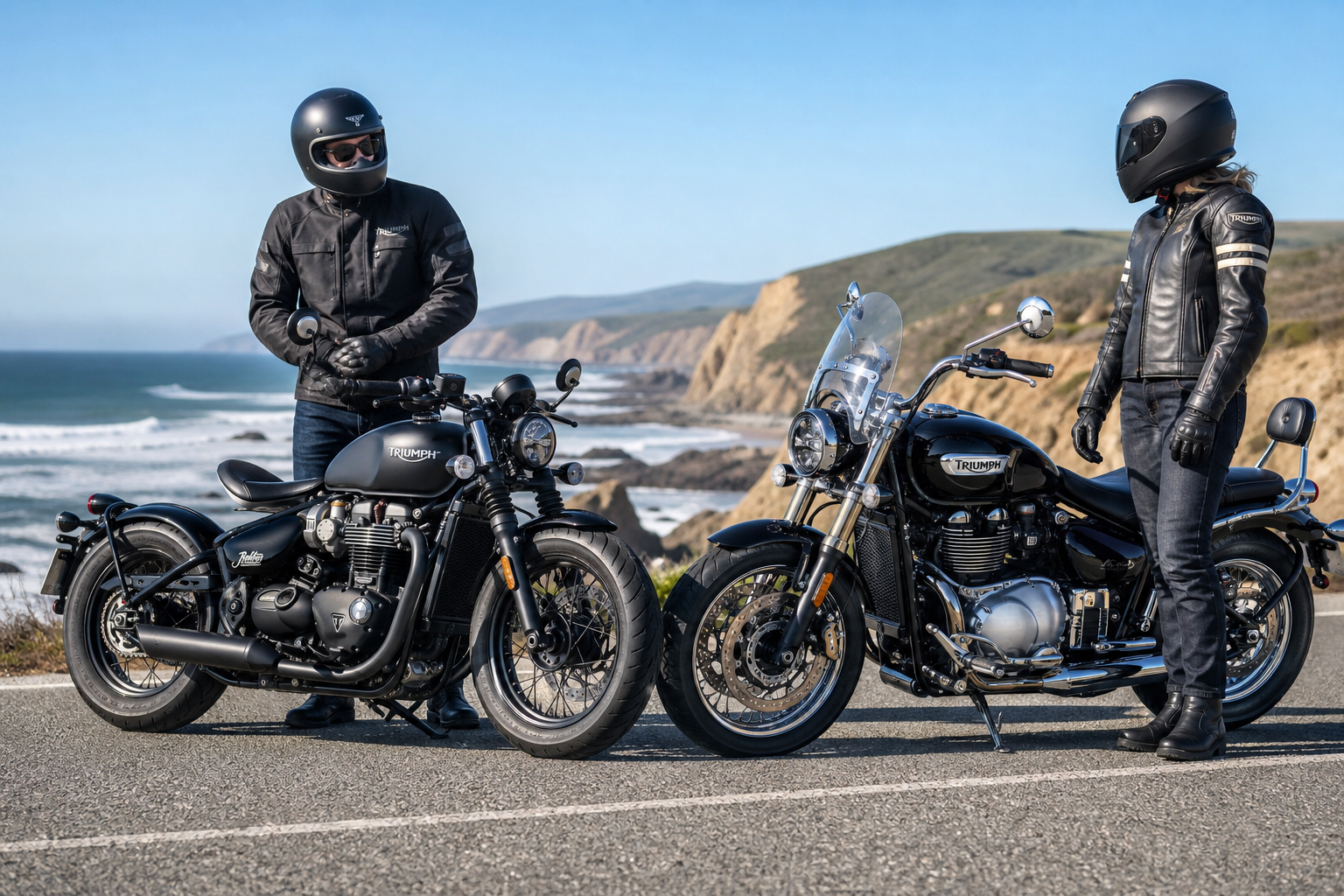
OVERVIEW — WHY THIS PAIR MATTERS
The 2026 Bonneville Bobber and Speedmaster are not radical departures. They are precise upgrades that tighten the feel, improve comfort, and sharpen the high-torque character of Triumph’s 1200cc parallel twin. If you want classic British style with modern usability, these updates matter on the street and on longer rides.
WHAT’S NEW FOR 2026
Triumph kept the soul of the Bonneville family but refined the details. Both models share the same 1,198–1,200cc liquid-cooled, 8‑valve SOHC parallel twin with a 270° firing order, a bore of 97.6 mm and stroke of 80.0 mm, and a compression ratio of 10.0:1. Peak outputs are tightly controlled: the twins make roughly 78 PS / 77 bhp (57.5 kW) and deliver a broad wave of torque — about 106 Nm (≈78.2 lb‑ft) — very low in the rev range.
DESIGN & ERGONOMICS
The Bobber still reads as stripped-back custom: low, muscular, with that single floating seat and slash-cut silencers. For 2026 the seat profile is reshaped for more support and a slightly wider contact area; seat height ranges around 690–700 mm (27.2–27.6 in), which keeps the Bobber very confidence-inspiring at stops.
The Speedmaster leans into cruiser-comfort. Wider, foamier seats front and rear, revised handlebars, and a low center of gravity give it a more relaxed two-up posture. Seat height is 705 mm (27.8 in) and the wheelbase on both machines measures 1500 mm, so stability and planted long-distance manners are part of the package.
ENGINE & POWER DELIVERY
Same mechanical heart, different tunes. The Bonneville high-torque twin produces its peak power around 6,000–6,100 rpm depending on the model tune, with the torque peak available at low rpm — the Bobber’s figure is commonly listed at 4,000 rpm, while the Speedmaster’s peak torque arrives around 3,750 rpm. In real-world riding that equals effortless roll-on in town, strong midrange for sweeping bends, and relaxed highway revs in sixth gear.
Throttle feel is refined thanks to electronic fuel injection and ride-by-wire. The low‑end shove is immediate thanks to the 270° crank; there’s character in the delivery, not just numbers on a sheet.
CHASSIS, SUSPENSION & BRAKES
Both bikes use a tubular steel twin‑cradle frame with a twin-sided swingarm. Front suspension is a Ø47 mm Showa cartridge fork, rear is a preload-adjustable mono‑shock RSU with linkage (KYB on the Speedmaster spec sheet in some markets). Wheel specs are classic wire-spoke 16-inch rims: front 2.5", rear 3.5".
Braking hardware is substantial for the class: twin 310 mm Brembo discs up front with 2‑piston calipers and a single 255 mm rear disc. ABS is standard and works cleanly — firm initial bite, then progressive slow-down at greater force. The net result is predictable, strong braking without surprises.
ELECTRONICS & RIDER AIDS
Triumph kept the electronics elegant rather than invasive. Expect a basic yet well-executed instrument cluster: analogue speedo with integrated LCD, selectable riding modes (Road and Rain on the Speedmaster), traction control, and a USB‑C charging socket. No long menu dives. Just the functions riders actually use.
PRACTICALITY & OPTIONS
The Speedmaster is the more practical of the two: a more comfortable pillion seat, better luggage options, and a wider fuel tank on spec sheets — noted capacity is around 14 litres for the Speedmaster and roughly 12 litres on the Bobber depending on market configuration. Both accept Triumph accessories for racks, sissy bars, and solo/two-up seat swaps.
ON THE ROAD — REAL WORLD IMPRESSIONS
City rounds, canyon runs, or empty A‑roads, the same twin behaves like a large-displacement single that’s been taught fine manners. The Bobber feels more thrown‑back and direct. It’s lively on entry to bends and rewards weight-transfer steering with a quick, confidence-boosting turn-in. The Speedmaster soaks miles; its ergonomics mean you arrive fresher after a day’s ride. The extra foam in the Speedmaster seat and the relaxed hand position change the day entirely.
In traffic the low-speed torque and smooth clutch make either bike easy to manage. On open roads the pulse of the twin and the exhaust note — deeper at idle, with controlled crackle on the overrun — gives both models real personality without being intrusive to neighbors.
SERVICE, WARRANTY & COSTS
Triumph lists a two-year unlimited mileage warranty on many markets with recommended service intervals consistent with modern classics — check local dealer pages, but expect the brand’s standard 12‑month inspection cadence and longer service intervals for major checks. Starting price for the family in some markets is shown from around $14,795, though optional accessories and destination fees push the final tag higher.
WHO SHOULD BUY WHICH?
- Choose the Bobber if you want custom attitude, a more engaged feel, and a machine that’s as much a style statement as a transport tool.
- Choose the Speedmaster if you want long-distance comfort, practical two-up capability, and classic cruiser ergonomics without sacrificing modern handling.
FINAL THOUGHTS
Triumph’s 2026 updates are about refinement. The twin’s torque map, revised ergonomics, and smarter fit-and-finish make these Bonnevilles more usable without dulling the character. They’re not for riders chasing superbike numbers; they’re for riders who want character, usable power, and a motorcycle that performs well in everyday life while still looking the part.
QUICK TECH SNAPSHOT
Engine: Liquid-cooled parallel twin, 8-valve, SOHC, 270° — ~1200 cc
Power: ~78 PS / 77 bhp (57.5 kW) @ ~6,000–6,100 rpm
Torque: 106 Nm (≈78.2 lb‑ft) — available low in the rev range (≈3,750–4,000 rpm)
Front Suspension: Ø47 mm Showa cartridge forks · Brakes: Twin 310 mm Brembo front, 255 mm rear · Seat Height: Bobber ~690–700 mm · Speedmaster 705 mm · Wheelbase: 1500 mm
If you’re choosing one, ride both back-to-back. The numbers tell you the capability; the seat and bars tell you whether you’ll enjoy the ride every mile.


0 Comments