

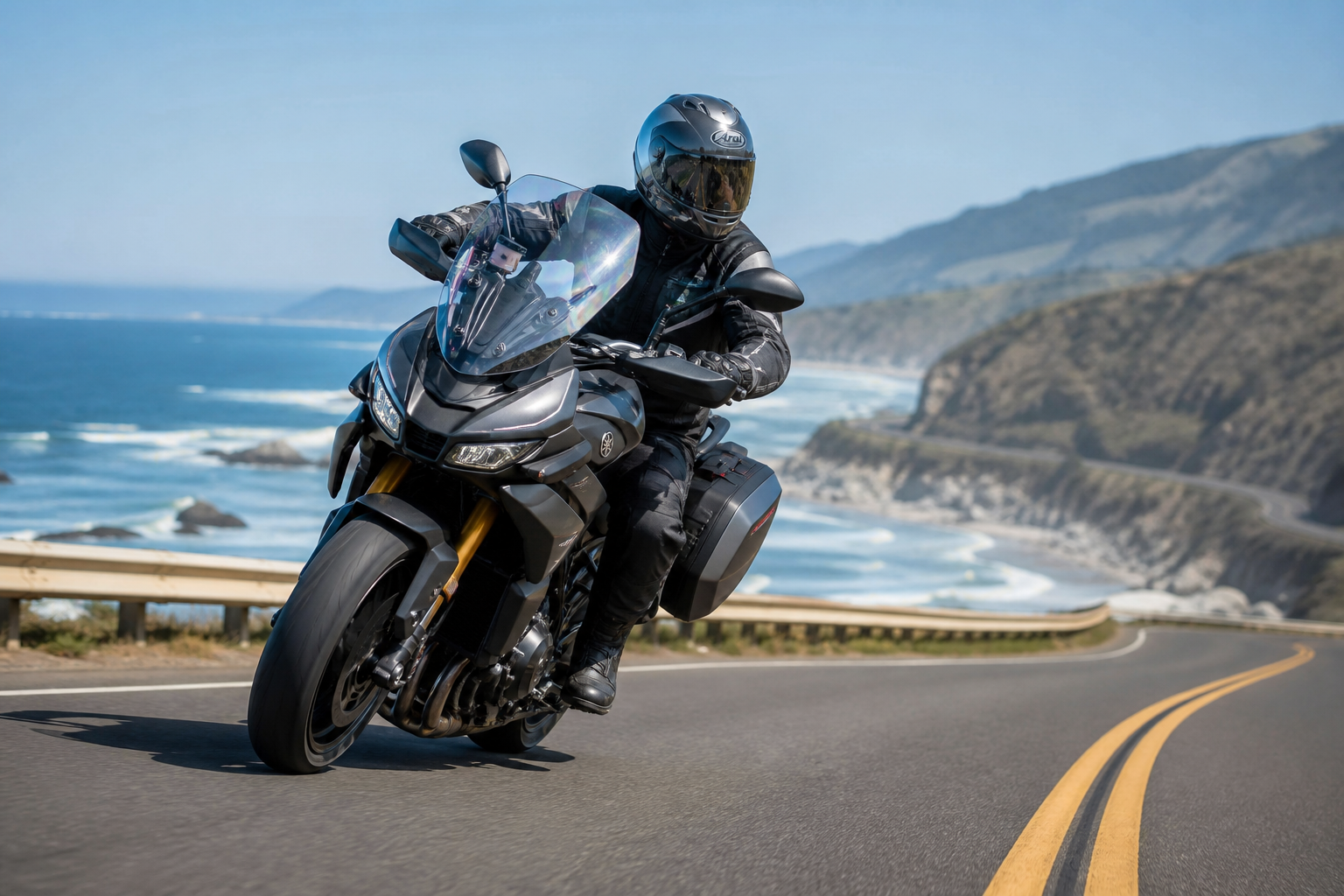
Why Defensive Riding Still Saves Lives
Motorcycling rewards focus and skill, but it does not forgive mistakes. Federal data shows that in 2023 there were 6,335 motorcyclist fatalities on U.S. roads. A federal safety agency also reports that, on a per-mile basis, riders are roughly 27 times more likely than passenger car occupants to be killed in a crash. Those numbers are not abstractions—they’re a reminder that margins are thin and mistakes are expensive.
Human factors make the difference. Brake reaction times vary with age, fatigue and distraction. Laboratory studies show median brake reaction times near 0.5 seconds, while common safe-driving guidance uses a working range from about 0.5 to 1.0 seconds depending on alertness. That split-second matters: at 60 mph you cover roughly 88 feet each second, so perception and reaction can eat a huge slice of stopping distance before any brake lever is pulled.
How Stopping Distance Breaks Down
Stopping distance has three parts: perception (seeing the hazard), reaction (deciding and moving your hand), and braking (actual deceleration). Published road tests and rider-school data show wide variation, but a realistic practical range from 60 mph to zero for modern motorcycles is commonly reported between 120 and 180 feet depending on rider skill, road surface, tire condition and braking system. Elite braking by trained riders can clamp that distance toward the low end, but only with practice.
Core Defensive Riding Strategies Every 2026 Rider Must Use
These are not academic tips. I teach them on tracks and in commuter clinics. They work the first time because they increase time and space—two things that beat surprises.
- See far, scan often. Look at least 12–15 seconds ahead in traffic. Shift your gaze: mirrors, near zone, far zone. Re-establish a mental picture of the road every 2–3 seconds.
- Cover the controls. Keep your right hand ready over the front brake and your feet positioned to shift and rear-brake instantly. That half-second of mechanical latency is often decisive.
- Choose lane position for visibility. Place yourself where other drivers naturally look and where escape corridors exist. Avoid the blind center of a lane when passing large vehicles.
- Maintain a space cushion. At highway speeds, leave a minimum three-second following gap; increase that in town, on wet pavement, or in heavy traffic.
- Manage your speed. Arrive slowly into intersections and ride at speeds that let you stop within visible space. Speed robs options faster than any corner.
- Assume you’re invisible—but don’t ride paranoid. Expect drivers to make imperfect lane changes and never count on them to see you. Make yourself conspicuous: deliberate lane placement, predictable inputs, and a high-visibility jacket when possible.
Intersections: The Biggest Risk Zones
Intersections are where the majority of motorcycle collisions with other vehicles happen. Drivers turning left or pulling out rarely see a bike until it’s too late. Make intersection riding active, not passive.
- Slow before you enter. Reduce speed to a level where you can stop if a car turns in front of you.
- Use flash-to-pass techniques safely. When visibility is poor, a short headlight flash can prompt recognition—don’t rely on it as a fix.
- Establish eye contact. If you can make it, eye contact with a driver reduces uncertainty. If not, act defensively.
Braking: From Routine to Emergency
Good braking is smooth, progressive and practiced. Emergency stops should be a practiced reflex, not a guess.
- Progressive pressure. Start firm on the front brake then add pressure. On most modern bikes, firm, steady pressure is faster than grabbing the lever and locking the tire.
- Use both brakes. The front provides most stopping power; the rear stabilizes. ABS-equipped bikes allow more aggressive inputs with less risk of lock-up.
- Practice panic stops. On safe ground, perform repeated stops from speed to build muscle memory and to feel your bike’s threshold braking and ABS behavior.
Traction, Tires and Smooth Inputs
Traction is the motorcycle’s only link to the road. Everything else is attitude. A contact patch the size of your palm handles acceleration, braking and cornering—so you must respect it.
- Tire condition. Check tread depth and sidewalls. Replace tires at the first sign of dry rot or uneven wear.
- Proper pressures. Use manufacturer cold-pressure settings and adjust for load and temperature. Incorrect pressure shrinks your contact patch or changes handling unpredictably.
- Smooth throttle, brake and steer inputs. Abrupt steering or throttle can shift weight and reduce traction instantly. Smoothness preserves grip.
Riding in Wet, Low-Light and High-Traffic Conditions
Change your baseline. Wet roads drop traction; dusk and night reduce conspicuity; heavy traffic increases unpredictable movements.
- Double your following distance in the wet and add more time at night.
- Warm tires before pushing corners. Cold rubber has dramatically reduced grip—ride like the first five minutes of a commute.
- Use reflective panels and a steady headlight beam. Brake and turn a fraction earlier; let other drivers react to you, not the other way around.
Mental Preparedness, Substance Use, and Fatigue
Data shows a significant portion of fatal motorcycle crashes involve alcohol. Another large slice involves fatigue or inattention. The safest ride begins before the engine is started.
- Ride sober and well-rested. If your judgment or reaction time isn’t sharp, you have no business on two wheels.
- Perform a quick pre-ride checklist. Tires, brakes, lights, fluids and fasteners. Ten minutes spent is time saved later.
- Know your limits. Push them at a closed course, not during the morning commute.
Practical Drills to Build Defensive Skill
Practice is non-negotiable. Advanced riding courses compress decades of experience into drills you can repeat safely.
- Emergency stop drill: From a moderate speed, cover the brakes and stop hard to a painted line. Repeat until speed-to-stop consistency is constant.
- Slow-speed balance: Practice clutch-and-throttle control in a parking lot to lower stalls and improve maneuverability.
- Brake-then-avoid: Combine a firm stop with a controlled lane change around a mock obstacle. This builds the split-second decision process you need on the street.
Gear That Protects and Gives You Time
Helmet and clothing choices change outcomes. A DOT-compliant helmet that fits correctly dramatically reduces the likelihood of catastrophic head injury. Full gauntlet gloves, armored jacket, and boots are necessary insurance.
- Choose certified helmets. DOT or ECE-certified helmets matched to your head shape reduce rotational and impact forces.
- Wear layered armor. CE-rated back and chest protection can change a hospital visit into a bruise.
- Visibility matters. High-visibility colors and reflective strips improve detection, especially at intersections.
Final Action Plan: What to Do This Week
Practical steps you can check off:
- Book an advanced riding course and mark it on your calendar.
- Do a full pre-ride inspection today: tires, lights, fluids.
- Practice one emergency stop and one slow-speed balance drill in a safe area.
- Commit to no alcohol or impairing medications before riding.
From the Instructor’s Seat
On the track I’ve watched confident riders save seconds with a single habit: they prepare for the unexpected. On the street I’ve seen the same habits turn potential collisions into near-misses. Defensive riding is not about paranoia. It’s about buying time—time to see, time to decide, and time to act. Those extra seconds are the lives we keep.
If you ride in 2026, take the proven steps above. Practice deliberately. Dress to survive. And treat every intersection as a live test of your ability to prevent a crash. Your odds improve the moment you make defensive riding a habit.


0 Comments