

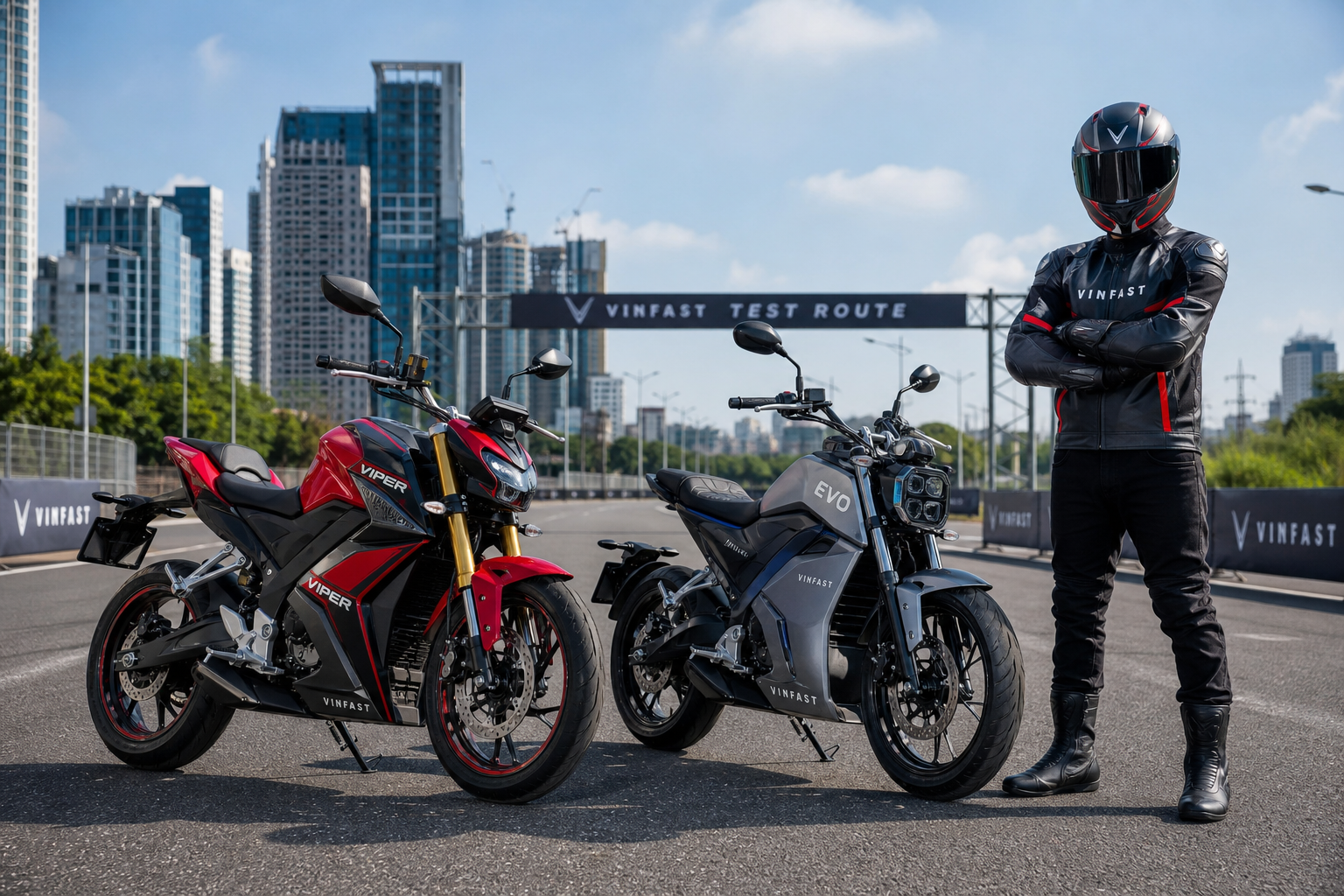
The arrival of VinFast’s Viper and Evo in 2026 is not a small ripple. These machines are a deliberate push into high-volume urban mobility with features and packaging that change buyer expectations. This article breaks down what the two models actually offer on paper, how they feel on the street, and why their combination of range, features, and pricing could re-order the market for electric two-wheelers.
What VinFast Announced — Straight Facts
VinFast launched a family of new electric scooters for 2026. The two headline models here are the Viper and the Evo. VinFast’s product notes and early spec sheets provide the baseline figures that matter to riders and fleet buyers.
- Viper: Uses a BLDC in-hub motor rated at about 3,000 W. Top speed is listed up to 70 km/h. Claimed single-charge travel figures appear in the 145–156 km window depending on configuration and battery option. Key kit includes a Smart Key with remote on/off and tracking, LED projector headlight, and dual rear shock absorbers with auxiliary oil reservoirs.
- Evo: Positioned with flexible battery options and a slightly different power profile—VinFast lists an in-hub motor figure and configurations that target the same 70 km/h top speed for the standard Evo, plus an Evo Lite variant restricted below 50 km/h (license-free in some markets). VinFast states the Evo can reach up to 165 km with two fully charged batteries under standard test conditions. The company also offered an early pre-order price for Evo in Vietnam at VND 19,990,000 (battery excluded).
How These Specs Translate on the Street
Numbers tell half the story; packaging and real-world behaviour supply the rest. The Viper’s 3 kW in-hub motor gives instant low-end punch and easy urban overtakes. The top speed around 70 km/h is sufficient for mixed urban / short-suburban runs; it’s not a highway machine, but that’s not its purpose.
The Evo’s two-battery range option puts it in a different class for commuters who routinely exceed 50–60 km per day. The Evo Lite’s sub-50 km/h limit is a clear attempt to capture riders who want a license-free daily vehicle while still offering modern EV convenience.
Chassis, Suspension and Rider Feel
VinFast has paid attention to perceived ride quality. The Viper’s dual shock layout with auxiliary oil reservoirs points toward a more stable, controlled ride on uneven surfaces—useful in city traffic with potholes or poor surface transitions. Frame geometry and wheel sizes keep handling predictable rather than sporty; that’s intentional for commuter confidence.
Suspension tuning is conservative by design. That trades a little sportiness for compliance and passenger comfort—smart for delivery fleets and urban riders who want a calm, predictable machine at low speeds.
Battery, Charging Strategy and Practical Range
VinFast continues to push battery flexibility. The headline claim for Evo—up to 165 km with two batteries—creates practical range for two-day commuter cycles in many cities. Viper’s advertised single-charge travel figures (commonly cited near 145–156 km) also surpass older entry-level electrics that only scraped past 80–100 km.
Battery-swap compatibility, charging infrastructure rollouts, and the option to sell models without batteries (where allowed) are all market levers VinFast is using to lower total ownership cost and speed adoption.
Smart Features and Utility
Both models come with convenience features now expected on modern scooters: remote vehicle-finding, tracking, and remote on/off for anti-theft. LED projectors and smart ergonomics improve night visibility and daily usability. The Viper packs some premium touches that lift it above basic commuter scooters.
Who Each Model Is For
- Viper — Urban riders who want a slightly more robust ride and a scooter that feels premium without being a large-displacement bike. Small fleets and commuters who value convenience will like the Viper’s kit list.
- Evo — Riders who need longer real-world range or want the option for a license-exempt variant. The two-battery range option suits longer commutes and urban service tasks.
- Evo Lite — Younger riders, license-exempt commuters, and riders in jurisdictions with lower-speed vehicle classes.
Market Impact: Why This Matters
VinFast’s moves push several tensions in the market at once: better range at affordable price points, battery flexibility, and a dealer-backed distribution model. For established OEMs, the challenge is no longer electrification alone; it’s delivering convincing range, warranty and an aftersales network that matches a rapidly rising baseline expectation.
For fleet operators, the Viper and Evo lower operating friction. Longer ranges reduce downtime and the battery-swap approach reduces the capital tied up in charging infrastructure. That directly changes fleet procurement calculations.
Maintenance, Service and Total Cost of Ownership
Electric scooters simplify mechanical maintenance—no oil changes, fewer moving parts. But OTA updates, battery health, and swap-station reliability are now critical service variables. Buyers should evaluate:
- Battery warranty terms and replacement costs.
- The local presence of authorized service centers and spare-part availability.
- Real-world energy consumption figures across seasons.
Potential Weaknesses & Real Risks
Claims on range are conditioned by test protocols. Heavy loads, aggressive throttle use, and cold weather will reduce distance. The 70 km/h top speed limits highway usability and could constrain buyers who mix longer intercity runs with city commutes.
Market disruption will depend on aftersales, battery availability, and how quickly rivals respond with comparable range and features at comparable prices.
Verdict — Practical Takeaway for Buyers and Industry Watchers
VinFast’s Viper and Evo are practical, well-specified entries that shift the baseline for urban electric scooters. They’re not exotic performance machines. They are strategic products aimed at mainstream adoption: sensible power, meaningful range, and features that address theft, convenience, and fleet use.
If you ride mainly in town, need low running costs, and care about range without complexity, the Evo’s two-battery approach is compelling. If you want a slightly more substantial ride with premium touches, the Viper is the sharper commuter choice.
Buying Checklist
- Confirm the battery warranty and what’s included in the on-road price.
- Test-ride both models in loaded conditions (two-up if you plan to carry a passenger).
- Ask about local battery-swap network coverage and service center locations.
VinFast has put clear pressure on rivals by offering high-range, feature-rich packages at accessible positioning. For riders and fleet managers, that pressure is already changing the conversation from “Can an EV meet my daily needs?” to “Which EV best fits my route and cost plan?”
Final note: the specifications quoted here are taken from VinFast’s 2026 product announcements and public spec listings. Always verify the exact configuration and local market specs before purchase—battery packs, top speed limits, and included hardware can vary by region.


0 Comments