

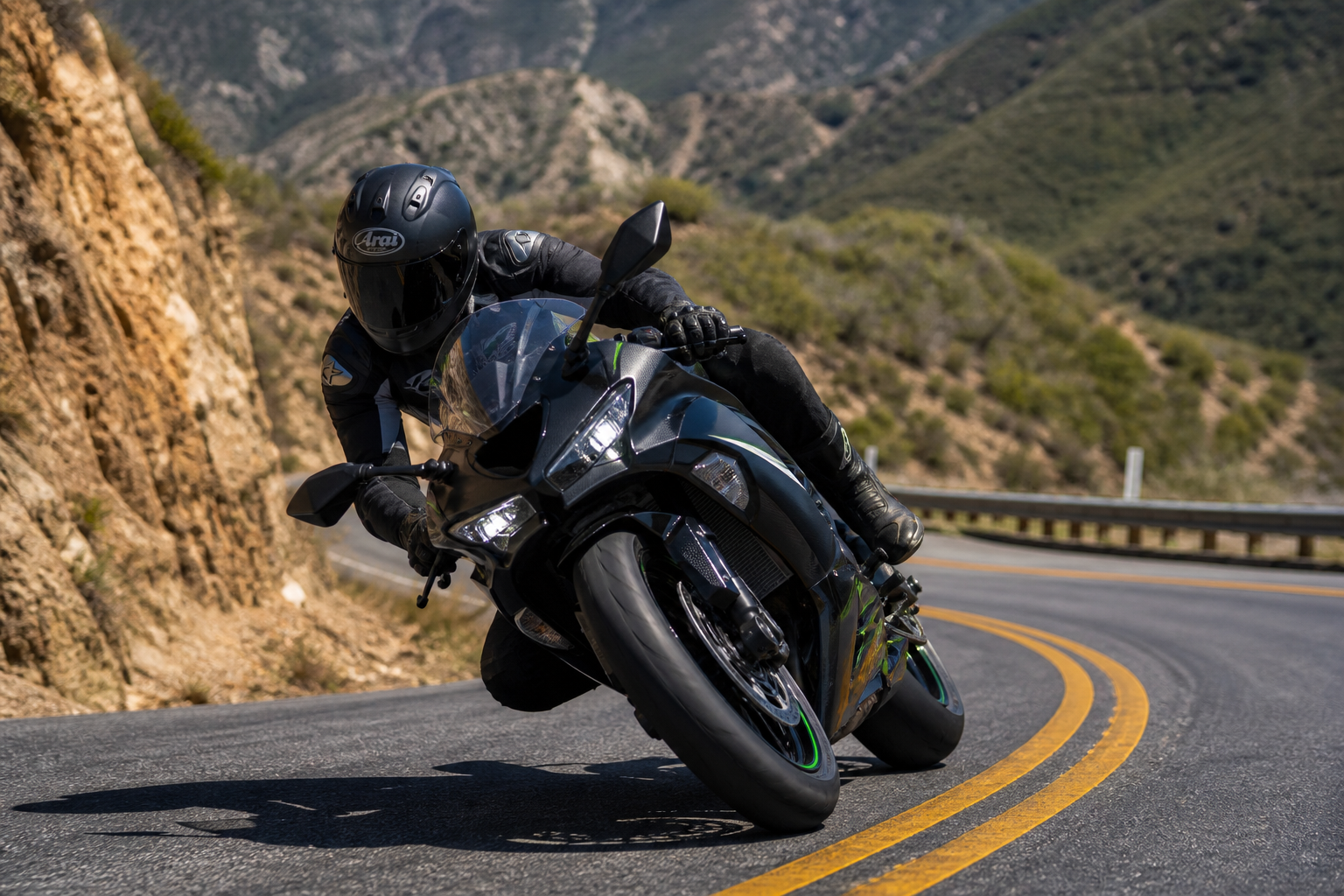
Why these maneuvers matter for 2026 riders
Riding today is not just throttle and brakes. Modern machines come loaded with electronic aids that change how you apply inputs and where you should focus your training. Get these core moves right and your confidence and safety jump noticeably — whether you commute, tour, or ride the occasional backroad.
What the bike’s electronics actually do
Most mid- and high-end motorcycles now use an IMU (inertial measurement unit) to measure roll, pitch and yaw and feed that data to systems like cornering ABS and lean-aware traction control. Yamaha introduced a six-axis IMU on flagship models like the R1 in the 2010s, and many manufacturers followed. The IMU lets the ECU adjust braking and engine torque while the bike is leaned over, which changes the margin between a routine ride and an avoidable crash.
Countersteering: the non-negotiable first skill
Countersteering is how you initiate a rapid, predictable lean. Push the right bar to go right. Push the left bar to go left. It feels odd at first. That feeling becomes muscle memory after a few controlled repetitions on a quiet road or parking lot.
Do this drill: accelerate to 20–25 km/h, look to a point on the horizon, and pulse a gentle countersteer input for one second. Repeat, increasing the speed and the pressure as confidence grows. Keep your head up and your thumbs off the grips’ inside—small wrist movements of the handlebars are often enough.
Trail braking: slow in, control out
Trail braking is the skill of keeping a modulated brake input as you begin to lean into a turn, shifting the bike’s balance to improve front-end grip and line control. Done poorly, it upsets the chassis. Done correctly, it tightens your line and reduces speed smoothly.
Key steps: brake straight first, then progressively ease the pressure while initiating countersteer. Keep the front brake pressure gradual — sudden releases or abrupt inputs transfer weight unpredictably.
Emergency braking with modern ABS
The acronym ABS is simple: it prevents wheel lock by rapidly modulating brake pressure. On modern bikes with IMUs, cornering ABS can intervene while leaned, reducing the risk of a high-side or low-side when you need hard stopping in a turn. If you must stop quickly, clamp the brakes with firm, steady pressure and keep looking where you want to go. Let the system do the micro-modulation.
Practice this: in a controlled area, get to a speed you’re comfortable with and stop hard while focusing on smooth lever and pedal pressure. The sensation of the ABS pulsing is normal. Learn its limits by repeating the drill on different surfaces so you know how your bike behaves in wet, cold, or gravel-adjacent conditions.
Shifting like a pro: quickshifters and slipper clutches
Many 2026 motorcycles offer a quickshifter for clutchless upshifts and sometimes downshifts. The device senses the shift action and momentarily cuts ignition or fuel to unload the transmission so the gear engages cleanly. It’s faster and reduces rider workload, but it won’t replace clutch use for slow-speed maneuvers or emergency downshifts until you master timing.
A slipper clutch reduces rear-wheel chatter or hop under heavy engine braking. It lets the clutch partially slip when back-torque spikes during aggressive downshifts or hard braking into corners. The net effect: improved stability and fewer scary rear-end snaps.
Low-speed balance and U-turns
Low-speed skills are underrated. A confident U-turn or parking-lot maneuver stops more trips to the roadside and lowers stress. Keep the weight centered, eyes up, and use the friction zone of the clutch for fine throttle control. Practice figure-eights with graduated radii until you can balance throttle, clutch, and body position without relying on the rear brake to hold you upright.
Swerve and hazard avoidance
A decisive swerve is safer than panicked braking in many obstacles-on-road situations. To swerve effectively: look at the escape line, apply a small countersteer in that direction, and keep throttle steady. Avoid overbraking while turning — that’s when traction falls off fastest.
Body position and sighting
Move your head and eyes before your shoulders. On tighter turns, shift your torso slightly off the seat toward the inside of the turn but keep your lower body planted. This reduces lean angle for a given speed and gives you more margin. Always pick an exit point and keep your focus through it.
Tire and brake basics every new rider must know
Your tires are your primary safety system. Keep them at manufacturer-recommended pressures and watch tread depth. Temperature matters: cold tires offer less grip until they warm. Brakes require periodic checks — pads, discs, and fluid. Modern ABS systems benefit from fresh brake fluid and well-bedded pads so the modulation is predictable.
Progressive practice plan (6 weeks)
Week 1: Low-speed balance, tight figure-eights, clutch friction-zone drills.
- 30-minute sessions, 3 times that week.
Week 2: Countersteering pulses at 20–50 km/h on a quiet road; focus on smooth bar inputs and scanning.
- Include short, gentle lean drills.
Week 3–4: Trail-braking and controlled entry speeds into progressively tighter turns. Add one emergency stop session each week to build ABS familiarity.
Week 5: Swerve drills and avoidance courses. Combine with a practiced emergency braking exercise.
Week 6: Put it all together on a longer backroad ride. Keep it measured. The goal is consistent inputs under varied conditions.
Checklist before every ride
- Helmet, jacket, gloves, boots: full protective gear without compromise.
- Tires: pressure and visual condition check.
- Controls: levers, lights, and mirrors aligned.
- Brakes: lever feel and fluid level.
- Electronics: confirm traction control / ABS mode if your bike has multiple settings—choose the setting suited to the road and your skill.
Notes from the instructor’s seat
I’ve coached riders who dropped their speed by 20–30% simply by smoothing inputs and using trail braking correctly. Modern electronics add a safety net, but they don’t forgive sloppy fundamentals. Invest time in repetition. Short, focused practice beats occasional long rides when you’re trying to ingrain new skills.
Common mistakes and how to fix them
Stiff arms and panic braking are frequent culprits. Relax your grip and move your body to absorb changes. Don’t stare at the obstacle; your bike will follow your eyes. Over-reliance on electronics is another trap — know how your bike reacts without them so you can handle failures or unexpected conditions.
Final practical tips
- Record short laps with a handlebar-mounted camera to review line, head position, and brake timing.
- Ride with slightly lower tire pressure for confident feedback in cold conditions only if manufacturer permits; otherwise stick to specs.
- Use progressive throttle roll-on exiting turns — sudden application can trigger traction control and upset the chassis.
Where to go next
Take a day-long advanced riding course or a controlled track session. Real-world traffic teaches you unpredictability; a closed course lets you push and feel limits safely. Combine structured coaching with deliberate solo practice and your skills will solidify quickly.


0 Comments