

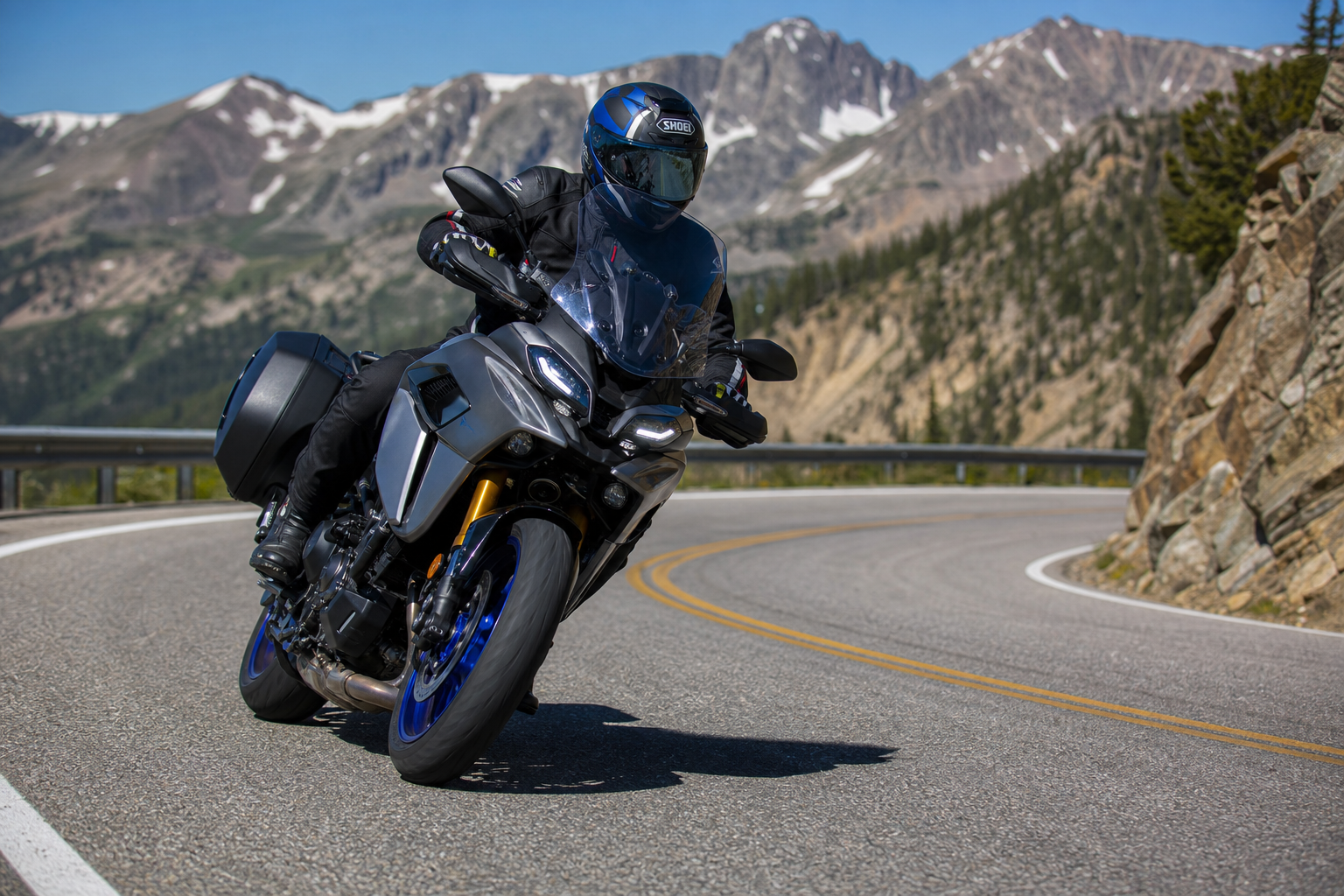
Why sharpen handling in 2026?
Riding fast and riding well are not the same thing. Tightening your technique reduces risk and gives you more fun per mile. These techniques are what separate confident riders from frantic ones when the pace picks up or when the road surprises you.
Countersteering: the foundation
Countersteering is what actually puts the bike on its lean. At typical road speeds you press the grip on the side you want to turn and the bike leans into the corner. That press is brief but decisive; the lean follows, and steering inputs then become fine corrections.
Practice drill: on an empty lot use gradual, deliberate presses to enter flowing arcs, then return to neutral. Focus on timing the press so the lean begins before you point the head into the turn.
Common fault: too much upper-body tension. Relax your shoulders, keep elbows soft, and let the bike find its balance. Your hands guide—your arms shouldn't try to muscle the chassis.
Trail braking with purpose
Trail braking lets you adjust entry speed and line simultaneously by holding and then progressively releasing front brake pressure as you lean. Used well it shortens braking distance and tightens turn entry; used badly it overloads the front tire.
How to progress safely: work the technique incrementally. Start on a low-risk track day or closed course. Enter the braking zone, scrub speed on a straight approach, then maintain a light, tapering pressure as you begin to lean. The goal is steady reduction of deceleration while the bike settles on the line you want.
What to feel for: the front end should feel planted as you ease the lever off. If the front washes, you were asking the tire for too much combined braking and lateral force. Back off, reset, and repeat the drill until the release is smooth and constant.
Body position and weight control
Advanced body work is subtle. It's not always about big hang-offs. Small, precise weight shifts change how the bike steers and how much grip is available at each tire.
Key points: keep your hips aligned with the tank, shift your inside butt cheek slightly off the seat for sharper entries, and use your outside knee and footpeg to control chassis roll. Keep your head over the inside handlebar and look through the corner where you want to go.
Do this: practice small shifts at low speed—feel how a millimeter of weight transfer changes steering balance. The aim is to be an input amplifier, not a wrestling match with the machine.
Suspension and steering damping basics
Suspension is the interface between rider inputs and what the tires feel. If the suspension is unsettled, all technique suffers. The goal is predictable, controlled responses to braking, roll, and bumps.
Adjustment priorities: set static sag, then balance front and rear damping for mid-corner stability. If you feel chatter or a nervous front end, soften compression slightly or increase rebound control according to manufacturer's guidance or a qualified tech's advice.
If you can, book a pro setup session. A properly tuned suspension will make the same inputs yield repeatable results—your learning curve will accelerate.
Electronics: use them like tools
Modern motorcycles come with advanced electronic aids. Cornering ABS, IMU-informed traction control, multiple ride modes, and quickshifters can magnify your capability when you understand their limits.
Practical approach: learn each mode on a closed course. Use traction control as a safety net, not a crutch. Turn electronic intervention down incrementally as your skill grows, but never assume the system will bail you out on a greasy surface or loose debris.
Line choice, vision and timing
Your line is your safety net. A clean, deliberate entry reduces corrections mid-turn and gives you room to react. Look farther than the apex—your hands and body will follow where your eyes are focused.
Adjust the apex for conditions: later apexes give more exit speed and margin if you need to accelerate early; earlier apexes tighten entry and can help on narrower roads. Practice both so you can pick the right option instinctively.
Drills that build advanced control
Structure your practice in short, intense sessions rather than endless laps. Quality repetition trumps quantity.
- Low-speed countersteer drills: figure-8s and fast transitions to hone the feel of initial presses.
- Progressive trail braking: start with braking-to-turn on an easy corner, then increase lean angle as confidence grows.
- Blind-apex runs: pick a corner with limited sight and practice holding a line to the exit—this forces precise vision and consistent inputs.
Common mistakes and clear fixes
Most errors are simple to identify and correct with focused practice.
- Too much brake in the turn: finish braking earlier or practice softer tapering of lever pressure.
- Gripping the bars: relax and use legs and core to stabilize; your arms should be connectors, not clamps.
- Reliance on electronics: train basic skills without aids periodically so you understand the bike's raw behavior.
Pre-session checklist
Before advanced handling practice always run a quick safety and setup check so technique work isn't undermined by preventable issues.
- Helmet and protective gear condition.
- Tire tread and correct pressures per the manufacturer placard.
- Brake lever feel and pad wear.
- Chain tension and lubrication.
- Basic fluid levels and fastener checks.
How to progress safely
Document what you do. Short notes after each session—what worked, what didn't—turn random practice into a deliberate plan. Add small challenges each week and never rush to replicate someone else's pace.
Seek instruction from qualified coaches and consider track days where you can push limits in a controlled environment. Real improvement comes from measured exposure, critical feedback, and repetition.
Final words to ride by
Advanced handling is a muscle memory game and a mental game at once. Keep your inputs small, your vision steady, and your commitment to safe progression stronger than your desire to impress. When you master these techniques, you'll have a bike that responds to you cleanly and predictably—every twist of road becomes a skill test you can enjoy, not fear.


0 Comments