

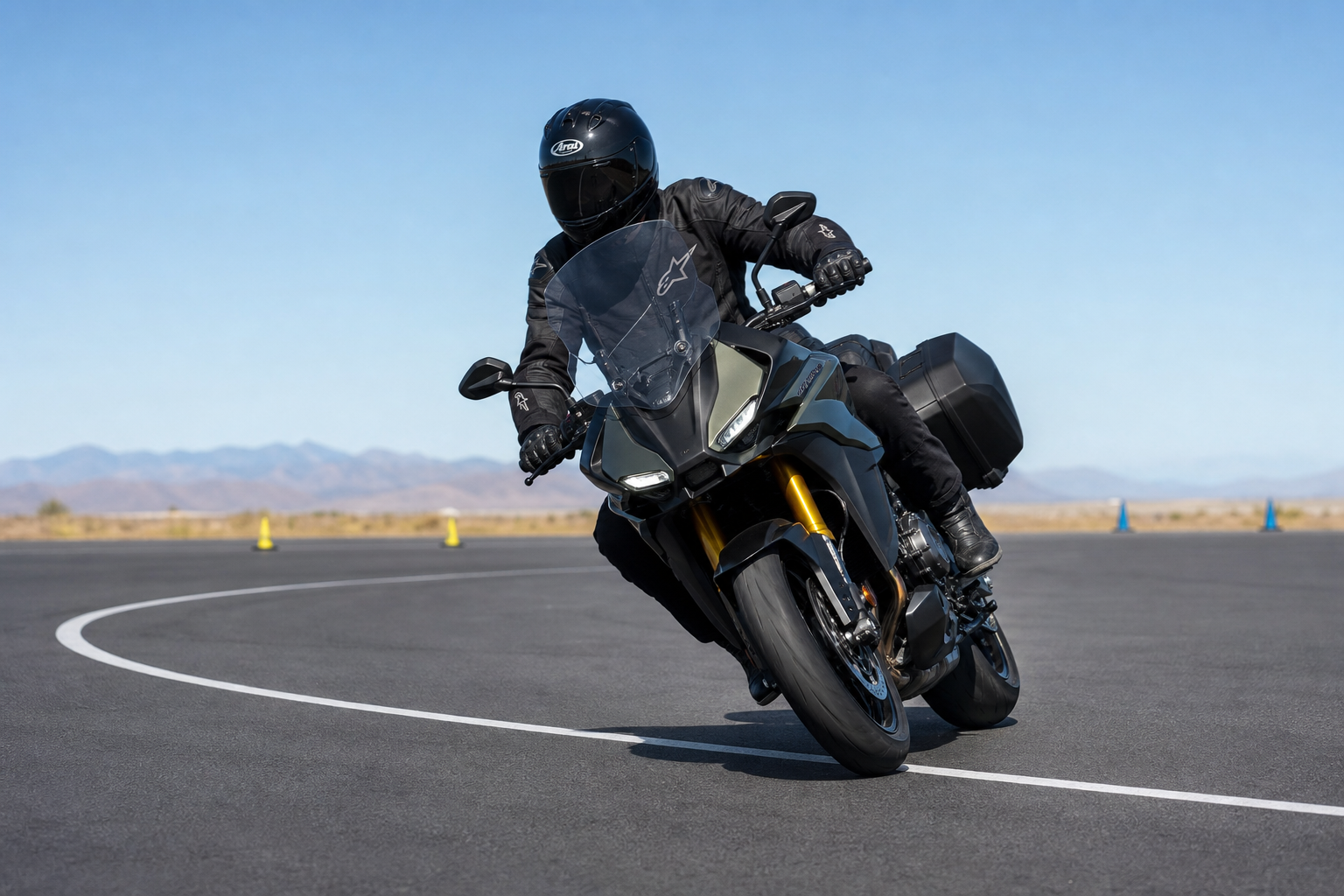
INTRO: WHY THE BIG O STILL MATTERS IN 2026
The "Big O" is simple on paper and brutally revealing in practice. Ride a constant-radius circle, hold it steady, and every flaw in your throttle control, balance, and input timing shows up. That makes the drill one of the most efficient ways to build real-world control—low speed or high. After years coaching street riders and track students, I’ve seen the Big O separate competent riders from those who are truly in command.
WHAT THE BIG O TEACHES YOU
At its core the exercise reinforces four mechanical truths: countersteering to initiate lean, precise throttle modulation to balance centripetal force, subtle weight distribution changes for steering, and keen awareness of the traction circle. Master those and tight turns, parking-lot manoeuvres, and emergency corrections become far easier.
SAFETY FIRST: KIT, SURFACE, AND RANGE SETUP
Never practice the Big O on public streets. Choose a closed pad, empty parking lot, or dedicated training area. Wear a full-face helmet, CE-rated jacket and pants or armor, gloves, and boots. On the bike, check tyre condition, tyre pressures to the manufacturer's spec, and brakes for clean feel.
THE PHYSICS YOU NEED, IN PLAIN TERMS
When you lean the motorcycle the contact patch provides lateral grip up to a limit. The faster you go for a given radius, the more lateral force you demand. The motorcycle balances those forces using lean angle and steering inputs. That balance is what you'll practice and expand in the Big O.
CORE SKILLS: COUNTERSTEERING, BALANCE, AND THROTTLE STEERING
Countersteering is not an advanced trick. It’s how you initiate a stable, controlled change of lean. Push gently on the outside bar to initiate the circle; hold the input as the bike sets to the desired lean.
Throttle steering is what follows: small increases roll the bike slightly upright, small decreases allow more lean. The goal is to let throttle be your balance tool rather than heavy steering corrections.
UNDERSTAND THE TRACTION CIRCLE
The traction circle idea teaches that tyres have a finite amount of grip that must be shared between braking, acceleration, and cornering. In a steady Big O you want to remain inside that circle comfortably — no sharp brake grabs, no sudden throttle spikes.
PROGRESSION: STEP-BY-STEP DRILLS TO MASTER THE BIG O
Build skill in stages. Each step introduces slightly more demand so your nervous system can adapt.
- Step 1 — Slow, wide circle: Walk the bike around a 6–8 metre radius at walking pace. Focus on smooth throttle and steady outside hand pressure. Look where you want the bike to go.
- Step 2 — Increase speed, same radius: Keep the circle but add a small, steady throttle input. Feel the bike's balance point. This is where throttle steering becomes obvious.
- Step 3 — Tighten radius incrementally: Reduce the circle size by a metre at a time. Make tiny steering and throttle changes, not big moves.
- Step 4 — Add entry and exit transitions: Enter the circle from a straight, hold the ring for several rotations, then smoothly return to the straight. This simulates real-world corner sequences.
ADVANCED TECHNIQUES: TRAIL BRAKING, STANCE, AND SUSPENSION TIPS
Once you can hold a steady Big O, add controlled trail braking to practice shifting load while maintaining a radius. Use the front brake only with a very light, progressive hand pressure; never a sudden clamp. The purpose is to slightly increase front-end load while entering tighter arcs, then trail off the lever as you settle into the circle.
Body position matters. Keep your torso aligned with the bike, head up, outside elbow relaxed and slightly bent. Too much upper-body tension fights the bars and wrecks smooth inputs. For suspension, a slightly firmer front preload and a touch more rear rebound can help stabilize steering at low speed — but always follow the bike manufacturer's adjustment ranges.
COMMON ERRORS AND CORRECTIVE FEEDBACK
Three mistakes recur in every class: jerky throttle, over-reliance on the rear brake, and looking at your front wheel. Correct them with focused repetition. Practice short bursts where you hold the circle for just two rotations, concentrating on only one error at a time.
MEASURABLE GOALS FOR PRACTICE SESSIONS
Turn your session into training blocks. Example:
- Warm-up: 10 minutes of slow balancing circles.
- Technique block: 15 minutes focusing only on throttle steering.
- Challenge block: 10 minutes adding light trail braking into tightened circles.
- Cool-down: 5 minutes easy riding and equipment check.
DRILLS FOR REAL-WORLD TRANSFER
Take the skill out of the cone zone and into the street. Practice slow turning at intersections, U-turn execution in parking lots, and controlled low-speed swerves that start from a steady circle. The control you develop in the Big O reduces panic and improves decision time on real roads.
TROUBLESHOOT: IF YOU CAN'T HOLD THE CIRCLE
If the bike wanders, isolate variables. First, check tyre pressures and temperature. Second, slow the target speed down and exaggerate throttle inputs so you can feel the trend. Third, film a run or have an instructor watch — small posture changes or grip tension often explain large tracking problems.
SESSION CHECKLIST FOR A PRODUCTIVE DAY
On the day: inspect tyres, check brake feel, confirm controls are free, pick a clean surface, and wear full protective gear. Start slow and build. Keep water and a logbook so you capture the specific input changes that produced improvement.
FINAL PRACTICAL ADVICE
Progress is seldom linear. Some days the Big O will feel perfect; other days the bike will fight you. The important part is deliberate, measured practice. If you approach the drill with patience and attention, your input precision and risk-management instincts will tighten in ways that no single theory lesson can match.
Go out, run the circle, make small adjustments, and trust the feedback from the tyres. The Big O rewards riders who can make tiny, consistent corrections.


0 Comments