

WHY 2026 FEELS DIFFERENT
Two years of steady engineering and a burst of practical infrastructure have pushed electric motorcycles from experiments into real choices for experienced riders. The change is not a single component. It is a set of technical upgrades that finally solve the old trade-offs: usable range, charge speed, thermal control, and software maturity.
KEY TECHNOLOGY SHIFTS THAT MATTER
Battery capacity and packaging: Premium road bikes are carrying packs in the mid-to-high teens of kilowatt-hours. Zero’s updated SR/F lineup uses integrated packs that push usable capacity into the high teens, while some long-range platforms now approach the 20–30 kWh zone for touring-capable distances.
Cell chemistry mix: In 2025–26 the market split is visible. Urban scooters and light commuters often favor LFP cells for longevity and safety; performance machines still lean toward higher-energy NMC formulations where energy density matters.
Cooling and thermal management: Liquid and oil cooling for motors and active thermal control for cells arrived across more models. That takes peak-power cutbacks off the table during repeated hard use — lap days or long mountain runs.
Fast charging and on-board chargers: Built-in DC fast-charge capability moved from boutique to mainstream on several 2024–25 launch bikes, shortening charge stops to practical 20–40 minute windows for many real-world rides.
Vehicle software and OTA: Over-the-air updates and mobile app integration are no longer marketing buzzwords. They actively change performance maps, regen behaviour, and range estimation during a bike’s lifecycle.
2026 MODELS WORTH RIDE-TESTING
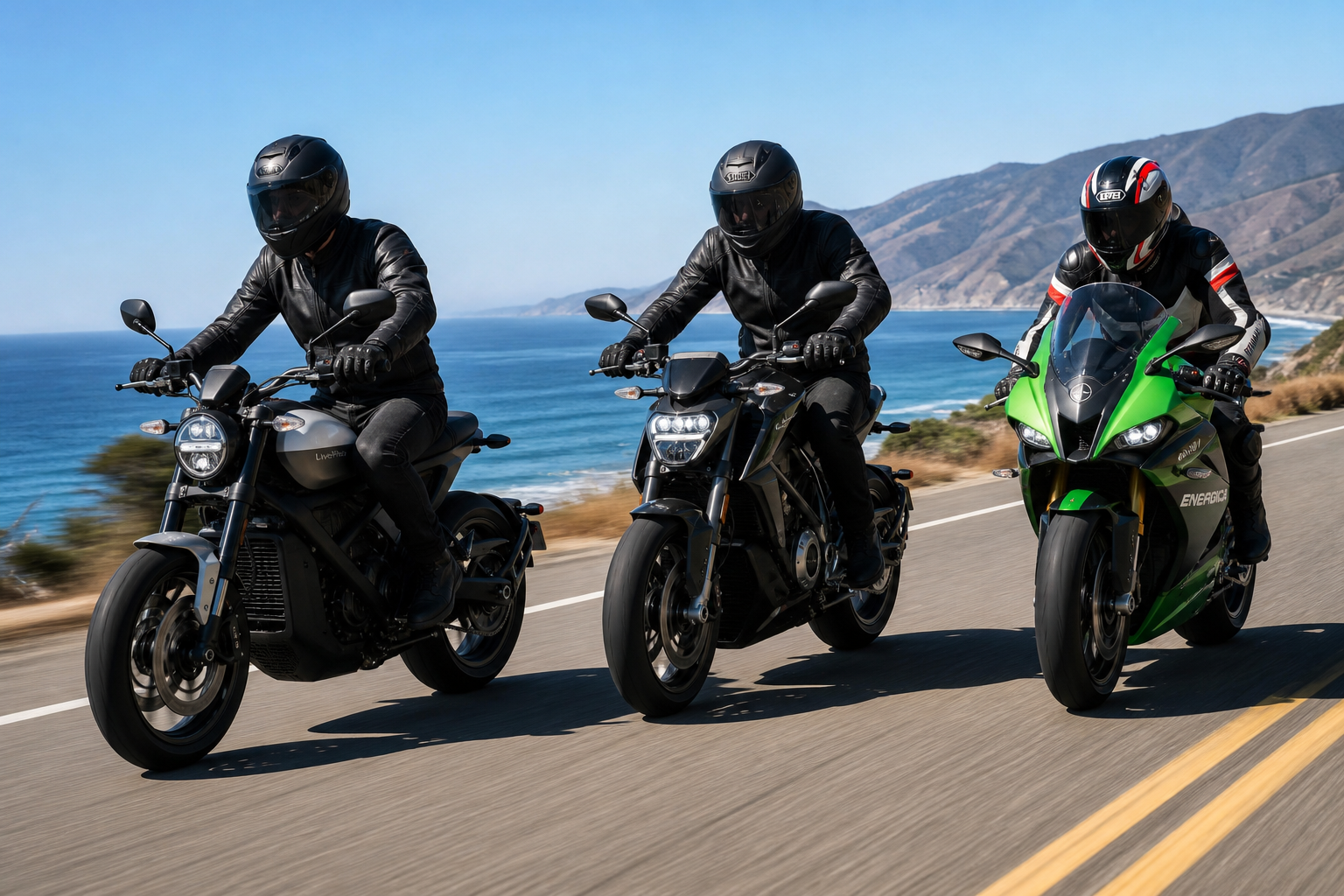
The field is broad, so I picked representative machines that illustrate where the industry landed this year: urban efficiency, fun naked performance, and sport/track-capable hardware.
Zero SR/F — premium naked, now more capable
Zero’s SR/F platform remains a benchmark for electric naked bikes. Current specs list a peak torque figure around 190 Nm and top speeds near 200 km/h, with city-oriented ranges in the low hundreds of kilometres when equipped with the larger power pack options. Zero’s focus was clear in 2025: larger integrated battery options and refined motor controllers to reduce energy losses on medium-high load rides.
LiveWire S2 Del Mar — light, connected hooligan
LiveWire’s S2 Del Mar trades raw battery size for a compact, agile package. The model emphasizes software features, a refined chassis, and commuter-friendly ergonomics. Published numbers put the curb weight in the mid-400s (pounds) and real-world peak outputs that make it lively in town and on the twisties. The Del Mar shows the payoff when OTA and connected systems are executed well: continual ride-mode tuning without visiting the dealer.
Energica Ego — track-bred performance
Energica’s Ego remains one of the stiffest performance statements on two wheels. Public specs show peak power figures in the high-horsepower range (roughly 160–170 hp depending on map) and torque numbers over 200 Nm in certain versions — hardware derived from racing work. Those numbers mean track viability; thermal controls and stronger charging helped reduce range anxiety for spirited riding.
BMW CE 04 and urban-scene scooters
Not every electric success is about peak digits. The BMW CE 04 and similar urban models kept the focus on commuting comfort, packaging and quick top-ups. Expect brisk acceleration for intersections, top speeds suited for city/highway mixes, and fast-charge options that reduce downtime for daily use.
REAL-WORLD RANGE: WHAT TO EXPECT
Published lab numbers are just the start. There are three practical classes in 2026:
- Urban commuters (2–6 kWh): Efficient, lightweight packs for short hops and dense city use. Quick charging and low mass make them economical and nimble.
- Mid-range road bikes (10–18 kWh): The sweet spot for weekend riders: enough range for a two- or three-hour ride with spirited sections and reserve for returning without a charge stop.
- Long-range/touring platforms (20–30 kWh): These are now viable for multi-stop touring with fewer charge interruptions; they carry trade-offs in weight and cost but solve the “range anxiety” equation.
As an example of how this plays out: a 17.3 kWh pack on a modern road bike typically yields city ranges north of 150–250 km depending on riding style and regen strategy; a 21–30 kWh pack extends that significantly under conservative pace.
CHARGING ECOSYSTEM — FAST-CHARGE IS THE GAME CHANGER
Fast-charge infrastructure for motorcycles improved fast enough in urban corridors to make day trips practical. The two real wins for riders are:
- 20–40 minute top-ups: Many bikes that support DC fast charge can regain useful range in the time it takes to grab coffee and stretch legs.
- Integrated on-board capabilities: Bikes with stronger on-board chargers require fewer bespoke adapters and simplify public charging.
Plan route stops where charger power matches the bike’s acceptance rate. If the station’s output far exceeds the bike’s intake, you still benefit; if the station is weaker, expect longer stops.
MAINTENANCE AND LONGEVITY — THE NEW REALITIES
Electric drivetrains simplify routine service. No oil changes, clutch adjustments, or valve checks on many designs. But new maintenance realities appear:
- Battery health management: Keep cells between advised state-of-charge bands for longevity. Manufacturers increasingly publish usable capacity and recommended charging windows.
- Thermal system checks: Coolant and pump health matter on liquid-cooled motors. Scheduled inspections prevent power dropbacks when you need peak output.
- Brake and suspension tuning: Regenerative braking changes pad wear patterns. Suspension setup must account for heavier battery mass and lower centre of gravity.
RIDE TECHNIQUE ADJUSTMENTS FOR ELECTRIC BIKES
Electric torque delivery alters throttle control on both road and track. Here is a short, practical checklist I use with advanced students.
- Use regen as a tool: Controlled regen smooths corner entries and reduces brake heat. Practice one-handed transitions to feel regen thresholds.
- Throttle modulation: Instant torque makes small inputs count. Be precise when rolling on mid-corner to avoid lift-throttle snap reactions.
- Weight-awareness: Batteries lower the centre of gravity but add mass. Accept later braking markers and plan smoother line choices on technical roads.
BUYER DECISIONS IN 2026 — HOW TO CHOOSE
Ask three focused questions before committing:
- What is your daily riding profile? (Short commute, mixed-day rides, or touring.)
- Does the bike’s accepted charge rate match local infrastructure?
- How important is peak performance vs long-term cell longevity?
If your day is mostly urban, smaller LFP-based bikes win for cost and durability. If you lap a track or tour the high country, larger packs and liquid cooling win despite higher initial investment.
REALISTIC EXPECTATIONS FOR THE NEXT 12–24 MONTHS
Incremental gains, not magic. Expect further incremental battery energy density gains, broader roll-out of DC fast-charging suited to motorcycles, and smarter thermal systems. Software will continue to refine rideability and range prediction after you buy. Those are the practical advances that will change ownership experience more than headline horsepower numbers.
FINAL RIDE NOTES
As a rider and instructor I judge a machine by what it lets me do on real roads. In 2026 electric motorcycles finally let you plan a proper weekend without fretting about range, use public chargers efficiently, and extract meaningful performance at track pace when the hardware is aimed at that purpose. The industry has stopped promising miracles and started delivering usable engineering.


0 Comments